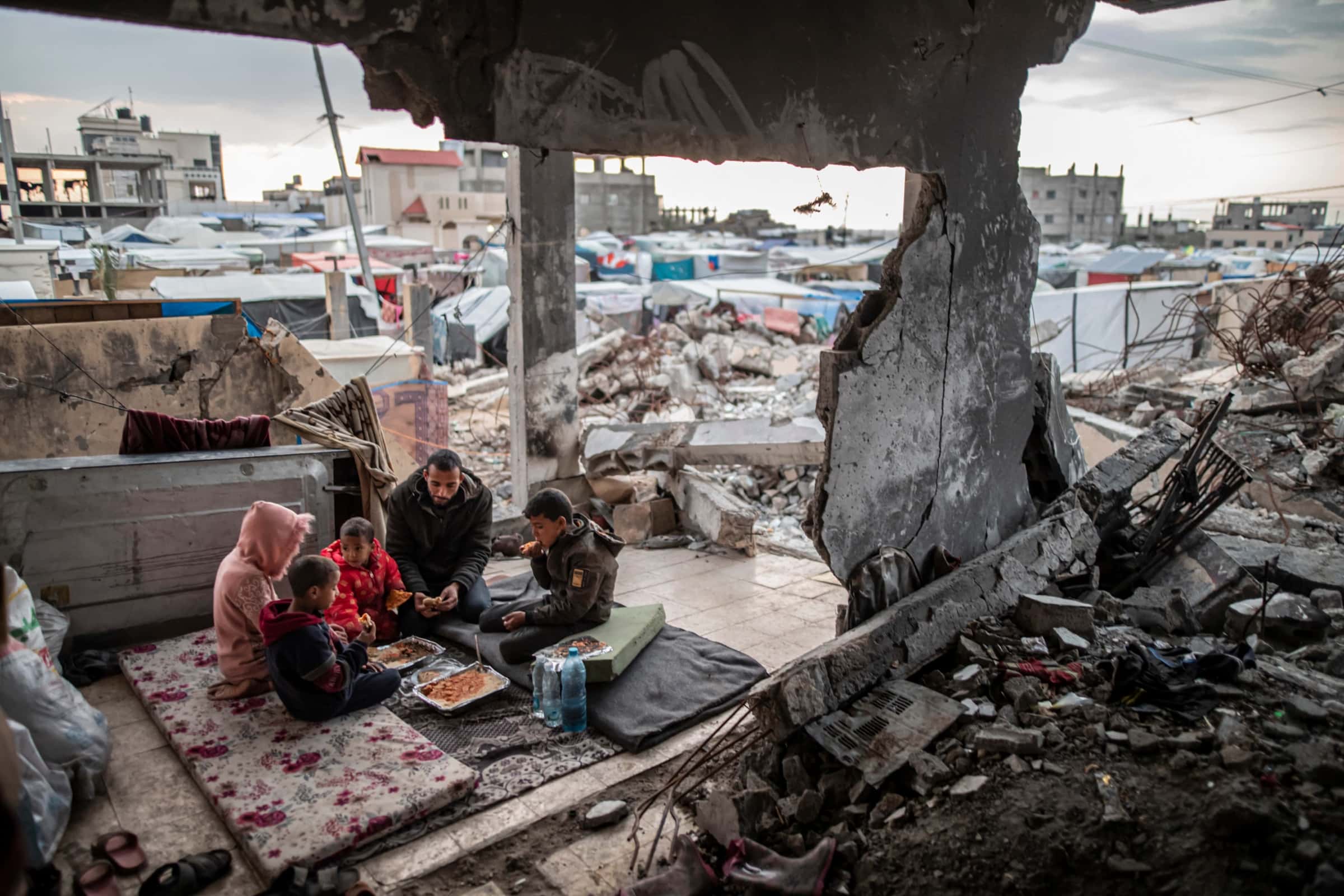
More than half of Gaza’s buildings have been destroyed and 13,000 children have been killed after the Israeli military has dropped thousands of bombs on the narrow strip of land that is home to more than two million people since the war began on 7 October 2023.
The Israel Defence Forces (IDF) has previously confirmed to Danwatch and Dagbladet Information that the F-35 aircraft are in operation in the Gaza Strip during the ongoing war against Hamas.
Now Danwatch, in collaboration with Information, can report that Israeli F-35 fighter jets with Danish military equipment are playing a central role in the massive bombings.
The aircraft, which are equipped with advanced military equipment from the Danish company Terma, are flying day and night, collecting data to identify bombing targets, dropping multi-ton bombs and causing massive destruction in Gaza.
This is according to a review of, among other things, Israeli TV interviews with F-35 pilots, US congressional hearings and the Israeli military’s social media, conducted by Danwatch and Information.
In a video released by the Israeli military on 2 November 2023, a pilot stands in front of an F-35 aircraft and on his uniform he wears the logo of the IDF’s Squadron 140, which is an F-35 squadron.
“We have carried out very significant attacks that seriously harm the Hamas regime in the Gaza Strip,” the F-35 pilot says in the video.
“In recent days, we have been working shoulder to shoulder with the ground forces, providing them with an air umbrella with enormous firepower,” the pilot continues in the video. He is the leader of Squadron 140 and in the video he is simply referred to as lieutenant-colonel ‘M’.
Military analyst Andrew Curtis, Associate Fellow at the Royal United Services Institute and former British Air Force officer, explains how the F-35 aircraft provides data that can be used to identify new military targets, among other things.
“The F-35 aircraft is not just a complex arms system, it is also a complex information system. In addition to bombing military targets with great precision, the aircraft collects intelligence that protects Israeli soldiers on the ground, while providing decision-makers in the IDF with data to identify new bombing targets,” says Andrew Curtis to Danwatch and Information.
The Danish-equipped F-35 fighter jets therefore play a central role in the war in a way that, for example, the Israeli F-16s cannot.
“It’s a paradigm shift, and something that Israel’s other fighter jets can’t match,” he says.
Interview
In a video released by the Israeli military on 2 November 2023, a pilot is interviewed in front of an F-35 aircraft and on his uniform he wears the logo of the IDF’s Squadron 140, “Golden Eagle”, which is an F-35 squadron.

The Danish-equipped fighter jets are also involved in Israel’s highly controversial use of so-called mega bombs in Gaza, one of the world’s most densely populated areas.
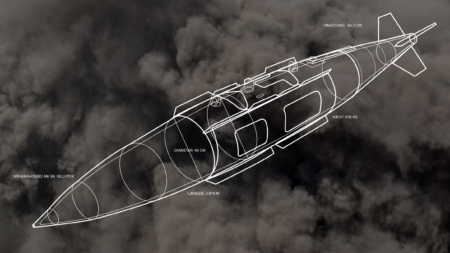
At just under 1,000 kg, the GBU-31 is one of the heaviest bombs in the Israeli military’s active arsenal, and according to the International Red Cross, the bomb is so powerful that it should not be used in urban areas.
In the first month of the Gaza war alone, Israel dropped more than 500 of the nearly one-ton GBU-31 bombs on the densely populated area, according to a CNN investigation. In comparison, the US-led coalition dropped only one multi-ton bomb during the entire war against Islamic State, according to the broadcaster.
The bombs can be lethal within a 300 meter radius and typically leave a 12 meter wide bomb crater. A report from a UN-appointed commission has previously warned that GBU-31 bombs “can rupture lungs and sinuses and tear off limbs hundreds of feet from the blast site” and “throw metal fragments a mile (1.6 kilometres) or more”.
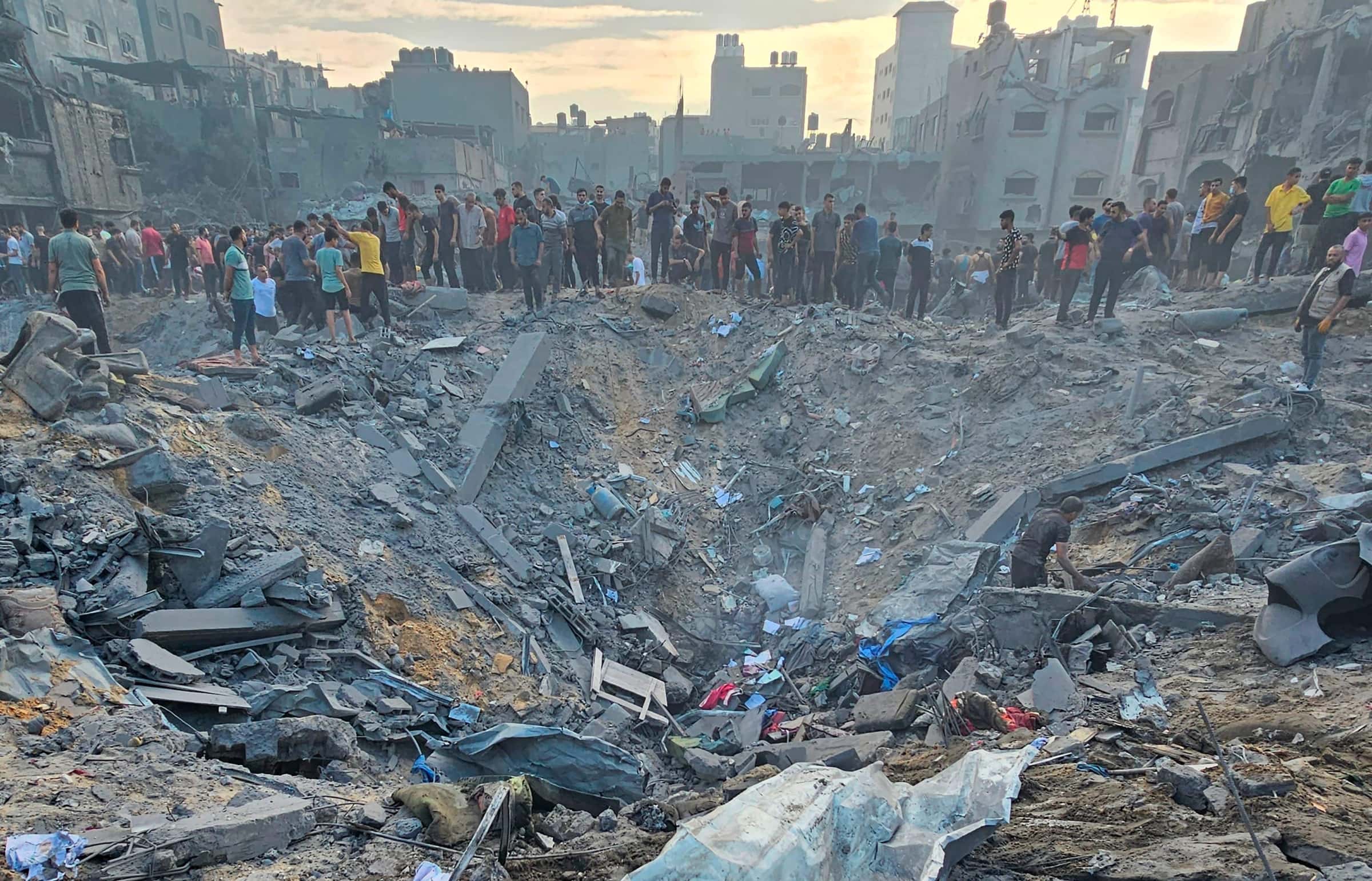
According to an article in The Guardian, several arms experts estimate that two multi-ton bombs, most likely GBU-31s, were used in the attack on the Jabalia refugee camp on 31 October 2023, one of the deadliest bombings of the war.
Hundreds of people were killed and injured, and the UN High Commissioner for Human Rights has expressed “serious concerns that the attack was disproportionate and may constitute a war crime”.
Danwatch and Information’s review of statements from Israeli military sources, as well as images posted by the military on its social media sites, show that the Danish-equipped F-35 fighter jets are bombing with the controversial, multi-ton bombs.
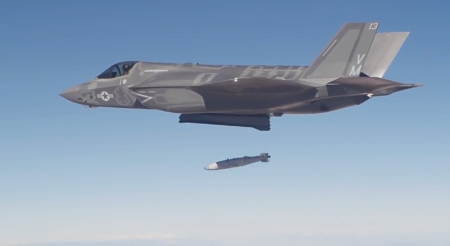
As previously reported by Danwatch and Information, the F-35 aircraft carry the multi-ton GBU-31 bombs as standard equipment in their internal bomb bays.
The bombs can also be mounted under the wings of the F-35 aircraft in the so-called “air-to-ground” pylons, of which Danish Terma is part of the production. This allows the aircraft to carry several of the multi-ton bombs on a single mission.
And according to the Israeli military, it is an innovation in this war that the multi-ton so-called JDAM bombs have been dropped from the pylons of the F-35 aircraft and not just from the aircraft’s internal bomb bay. It provides a “significant improvement” in the aircraft’s attack capability, according to an article on the Israeli military’s website from January this year.
“Adir (the Israeli name for the F-35) aircraft used to carry arms inside the aircraft, but today they can carry a larger number and use multiple types of bombs, providing flexibility and adaptability for multiple missions in one flight,” the article states.
Interview
The laws of war allow for civilian casualties if there is proportionality between the military advantage of an attack and the number of civilians who lose their lives. In a TV interview, an Israeli F-35 pilot says that she has never before been subject to such lenient restrictions on “collateral damage”, i.e. how many civilian casualties are allowed, as is the case during this war. The interview has been translated as an appendix to a court case in the Netherlands about exports to the F-35 program.

“For me, it’s very clear what the definitions are. For each target I want to attack, I know exactly what collateral damage is allowed”.
Have the definitions of “collateral damage” changed after 7 October?
“Of course they have changed a lot. I’ve never in my life seen such a ‘light hand’ [trigger happy, translator’s note] but it’s also balanced and well thought through, and not everywhere”.
How can you throw bombs like that when there are (Israeli, ed.) hostages underneath?
“I am aware of that. We are aware of that. The whole air force is concerned about this because it’s important for us at all levels to know that we don’t hit the hostages.”
In a press briefing on 6 November 2023, the IDF announced that Chief of Staff Herzi Halevi visited Nevatim, the Israeli military base approximately 65 km from Gaza City where Israeli F-35 aircraft are based.
“The F-35 fighter jets strike terrorist targets and assist ground forces in very close attacks – as close as 200 meters away,” the press briefing states.
According to several media, IDF Chief of Staff Herzi Halevi said during the visit to Nevatim that the F-35s bomb Gaza with heavy ammunition.
“We have never done anything like this. With very heavy arms and a very good correlation between what the ground forces need and what the aircraft can do,” said Herzi Halevi at the Nevatim base.
That the Danish-equipped fighter jets throw multi-ton bombs is also confirmed by an F-35 pilot from the IDF’s 116 squadron.
In an interview with Israeli TV station Channel 13 on 13 January this year, the pilot, who is also Israel’s only female F-35 pilot, says that it takes only a few minutes from when an officer among the troops on the ground requests air support for the Air Force to provide it.
And this is true regardless if the assistance comes in the form of a drone, a helicopter or one of the “one-ton bombs” that she carries on her aircraft, the F-35 pilot explains in the interview.
At the same time, the pilot says that she has never before been subject to such lenient restrictions – such a “light hand” – in terms of civilian casualties as she has been during this war. However, she adds that she still sees the approach as balanced.
Several images and videos posted on social media by the Israeli Air Force IAF apparently show the GBU-31 bombs being prepared and loaded onto F35 aircraft.
Danwatch and Information have presented Terma with images of GBU-31 bombs in the pylons of Israeli F-35 aircraft. Head of Press Kasper Hyllested denies that it can be concluded that the pylons contain parts from Terma.
“We are neither today nor historically the sole supplier of these parts. Neither we, you nor others can determine whether our parts are on certain pylons without having access to inspect the individual pylons very thoroughly”, Kasper Hyllested writes.
Terma works closely with the American Marvin Group on the production of pylons for the F-35 aircraft. Danwatch and Information’s research confirm that there has previously been another supplier of air-to-ground pylons for the F-35 program.
According to an article from the analysis company Forecast International from March 2019, written by a former Terma employee, Turkish Aerospace Industries (TAI) in early 2019 produced 45% of the air-to-ground pylons for the F-35 aircraft. The rest was produced by Terma (45%) and Marvin Group (10%).
Following the decision in July 2019 to exclude Turkey from the F-35 program due to its procurement of Russian arms systems, TAI no longer supplies pylons for the F-35 aircraft.
Lockheed Martin, the main contractor for the F-35 aircraft, confirms this in an email to Danwatch and Information:
“In accordance with the guidance from US Department of Defence, there are currently no Turkish suppliers supporting the production of the F-35,” they write.
In other words, it cannot be concluded that the pylons that hold the bombs under the Israeli fighter jets contain parts from Terma’s Danish factories – although there is a certain probability that they do.
This is also confirmed by Terma’s head of press.
“That there is “a certain probability” that these are pylons with parts from Terma is principally correct, but it is impossible to say with certainty,” Kasper Hyllested writes in an email to Danwatch and Information.
Regardless, Terma provides advanced military equipment for all F-35 aircraft.

According to Terma’s own website, the company has more than 700 employees working to produce more than 80 different parts for the F-35 fighter jets.
In an interview with Avisen Danmark in 2022, CEO Jes Munk Hansen stated that “not one F-35 flies without parts from Terma”.
Lockheed Martin calls Denmark an “invaluable partner” in the production of the F-35 aircraft. Both Lockheed Martin and Terma confirm that there are Danish parts on all F-35 aircraft being produced.
“All F-35s contain components produced by Terma and Multicut, including pylons, advanced composites, radar components and horizontal tail fins,” a Lockheed Martin press officer wrote in an email to Danwatch and Information on March 14.
“It is correct that the F-35 aircraft that today leave the Lockheed Martin factory in Fort Worth, Texas, all contain parts produced by Terma. These may for example be composite parts,” Terma’s head of press writes in an email.
The importance of the F-35 aircraft to Israel’s warfare is also evidenced by a US Congressional hearing that took place on 12 December 2023.
Here, the director of the F-35 program, US lieutenant general Michael Schmidt, said that during the war, the Israeli military has optimised the time it takes from when the F-35s land at the Nevatim base to when they are back in the air with fresh supplies of fuel and bombs.
“I last spoke with the IDF Chief of Staff yesterday. We can learn a lot from them in terms of how quickly they get aircraft back in the air,” the program director told the attending legislators during the hearing.
Congressional hearing
During a hearing in the US Congress in December 2023, it was revealed that the F-35 program is learning “tremendously” from Israel’s use of the F-35 in Gaza and has added “capabilities” to the aircraft during the war.
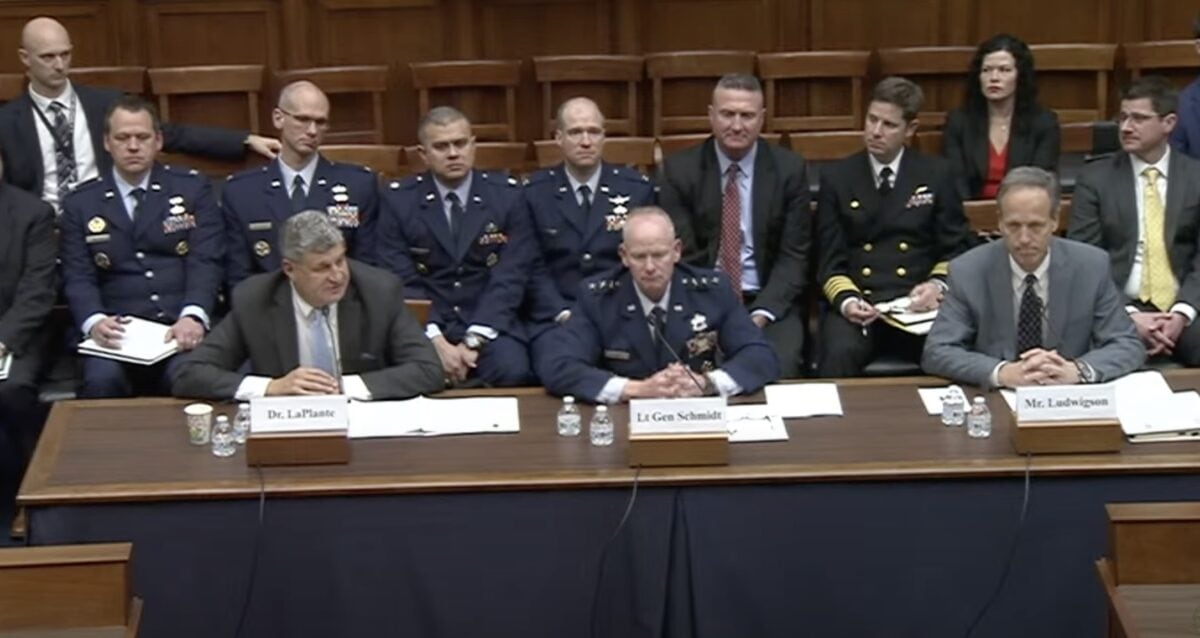
Military analyst Andrew Curtis does not doubt that the Israeli military will use the Danish-equipped fighter jets as much as possible.
“The speed, i.e. the IDF refuelling the aircraft and loading it with new arms so quickly while briefing the pilot for a new mission, definitely implies that the IDF is doing what it can to keep the F-35 in the air around the clock,” says Andrew Curtis.
“I’m sure the Israeli military flies as many missions as possible with the F-35, as the F-35 is the best way for them to support troops on the ground in an urban area where you’re dropping bombs very close to your own soldiers and therefore need them to be accurate, but also need the intelligence it generates,” he says.
The military analyst also highlights the many capabilities of the F-35 aircraft.
“One of the advantages of the F-35 is that it can play many different roles. It can provide close air support to ground forces loaded with a large number of smaller bombs in the morning, and then in the afternoon it can fly with the big JDAM bombs (the multi-ton GBU bombs, ed.) as it supports Israeli ground forces in the search for the Hamas tunnel system. It can do both,” he says.
The F-35 program, of which Denmark is a member, also provides direct support to Israel in connection with the war in Gaza, including deliveries of spare parts for the Israeli F-35 aircraft.
This was also revealed in the US congressional hearing in December.
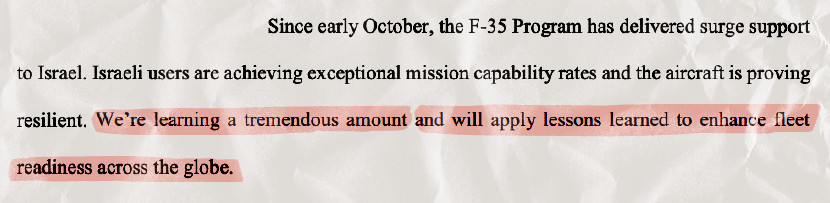
“Since early October, the F-35 program has been providing surge support to Israel,” said Michael Schmidt, director of the F-35 program.
He further explained that the “global maintenance infrastructure” of the F-35 program is currently being “tested through the current conflict in Israel” and that it has been instructive to “move parts around the world in support of a conflict”.
Michael Schmidt also said that the F-35 program has “added some capabilities” to the aircraft “in a very short time”.
The effort was praised by the chairman of the Congressional committee, Republican Rob Wittman, who highlighted how the F-35 program has acted “at breakneck speed to support our closest partner and ally in the Middle East, Israel”.
“They have done so by accelerating the F-35’s arms capabilities and increasing spare parts delivery rates in their fight against the atrocities committed by Hamas,” Wittman said.
Denmark is one of eight official partner countries in the F-35 program. In late January, Danish Minister of Defence Troels Lund Poulsen visited Lockheed Martin’s F-35 factories in the US to discuss Denmark’s role in the program.
Danwatch and Information have therefore asked the Ministry of Defence if and how Denmark, Danish officials, military personnel and companies have contributed to the F-35 program’s support for the Israeli warfare since 7 October.
However, the Ministry of Defence has not responded to the question by our deadline.
The Danish Minister for Foreign Affairs, Lars Løkke Rasmussen (M) has repeatedly stated that there is no basis for concluding that Israel has violated international law in Gaza.
And he has pointed out that the criticism of Denmark’s exports has not been based on concrete information about war crimes committed using the Danish-equipped F-35 fighter jets.
During a consultation in the Danish Parliament’s Foreign Affairs Committee in January this year, the Minister for Foreign Affairs said:
“I have to say – without sounding too harsh, but still – that the fact that there are F-35 aircraft in the air is not in itself something that may alter the outcome of this case”.
As Danwatch and Information have previously described, the Danish authorities have approved the export of military equipment for the F-35 program without assessing the risk of Israel using the equipment in connection with war crimes.
Since 2013, the F-35 program has been subject to a particularly lenient practice, which means that the Ministry of Foreign Affairs does not conduct a specific risk assessment according to the criteria in the UN and EU regulations, as is otherwise normal practice in other Danish military export cases.
This is a practice that legal experts have criticised as an illegal circumvention of international regulations, but which Minister for Foreign Affairs Lars Løkke Rasmussen has defended, among other things with reference to the fact that the United States is Denmark’s most important ally.
No posts
Danwatch and Information have shared the documentation presented in this article to the Danish Ministry of Foreign Affairs and the Ministry of Justice and asked whether the information will cause Danish authorities to reconsider whether it is in accordance with international law to continue the export to the F-35 program.
“We refer to the Minister’s previous statements on the matter,” reads the brief response from the Ministry of Foreign Affairs.
In a parliamentary response on 14 March, Minister for Foreign Affairs Lars Løkke Rasmussen writes that “he has noted” the Dutch High Court’s ruling on 12 February 2024. The case concerns the supply of parts for F-35 aircraft from a regional warehouse in the Netherlands directly to Israel. Likewise, he “has noted” the ruling of the ICJ on 26 January 2024 in South Africa’s case against Israel for violation of the Genocide Convention.
At the same time, “it is noted in relation to the F-35 cooperation that the consideration of Denmark’s foreign
and security policy interests continue to require that Denmark and Danish companies can enter into a close, binding cooperation with our closest allies, including the United States, and these countries’ companies with a view to strengthening Denmark’s strategic international and European supply chains and the development of defence materiel of importance to the security of both Denmark and Denmark’s allies.”
The reply states that the Ministry of Foreign Affairs “has temporarily encouraged the Danish National Police to consult the Ministry of Foreign Affairs regarding specific applications for the export of components for F-35 aircraft from Denmark”.
The Ministry of Justice refers to this parliamentary response in an email to Danwatch and Information:
“Since 15 February 2024, the Danish National Police has, in connection with the processing of specific cases, asked the Ministry of Foreign Affairs for an opinion on whether there are foreign and security policy conditions that mean that the application should not be granted in cases concerning equipment to be included in the F-35, where the recipient is specified as an EU, EFTA or NATO country and the end user is specified as unknown.”
At the same time, Lockheed Martin continues production of F-35 aircraft for Israel. Israel has ordered a total of 75 of the advanced F-35 aircraft and has so far received 39.
The Israeli military, IDF, declined to comment to Danwatch and Information on the role of the F-35 aircraft and the use of GBU-31 bombs during the war. Instead, a spokesperson refers to the IDF’s website, which states that the Israeli forces have “many measures to minimise civilian casualties” during its operations.
On the website, the IDF also writes that in their opinion, it is “first and foremost” Hamas that “bears responsibility for the widespread suffering it has caused by instigating the hostilities on 7 October and using civilians as human shields”.
Four organisations – Amnesty International Denmark, Oxfam Denmark, Mellemfolkeligt Samvirke and Palestinian Al-Haq – have recently announced that they will file a lawsuit against the Danish state for violation of the regulations in connection with Danish arms exports to Israel.
Juliet Kabuhgo remembers clearly when she met the father of her child. She was 17 years old.
“He called me several days in a row and asked me to meet him down at the market. One day I went down there and met him. He told me he loved me, but I didn’t understand because we had never met. After two weeks, he started sending me money. First 20,000 shillings, then 30,000 shillings (55 Danish kroner). Then he demanded that we have sex. I tried to refuse him, but he insisted,” she says.
Juliet Kabuhgo, who is 22 years old today, is one of 31 girls and women who say that from 2018 to 2022, they were impregnated and then abandoned by employees at the Nyamagasani Hydro Power Project, two hydropower plants where Danish energy company Frontier Energy is the majority shareholder.
Danwatch’s partner, the television station NTV Uganda, visited the village of Kyarumba at the foot of the tree-covered slopes of the Rwenzori Mountains and interviewed seven of the affected girls and women, as well as a number of other sources in the local area.
The women and girls talk about being persuaded and pressured into sex by men under contract with the Sri Lankan company VS Hydro, which built the Nyamagasani Hydro Power Project for Frontier Energy, and how they struggle to support themselves and their children today.
The fathers who came to Kyarumba from other parts of Uganda and Sri Lanka have all left the area again and the mothers are not able to get in touch with them.
“When I told him I was pregnant, he refused to believe it. Instead, he demanded that we have sex again,” says Juliet Kabuhgo. “I agreed because otherwise I was afraid he wouldn’t take responsibility for the baby. Afterwards, I tried to call him several times, but he just told me that it wasn’t his child and that I should have an abortion,” she says.
Kyarumba is located in the foothills of the Rwenzori Mountains, located in the border area between Uganda and DR Congo. Video: Joel Kaguta / NTV Uganda
According to Ivan Bwambale, the politically elected chairman of the Kyarumba sub-county council, an area in western Uganda with just over 25,000 inhabitants, fourteen of the girls were under the age of 18 when they became pregnant.
This is despite the fact that it is illegal in Uganda to have sex with anyone under the age of 18.
“Some of the girls were as young as 15-16 years old, and there are also four who have been diagnosed with HIV,” he says. “It’s a very unfortunate situation and we hope that these single mothers will soon get some help,” he says.
Ivan Bwambale’s information is confirmed by several local sources that NTV Uganda has spoken to.
The Danish company behind the Nyamagasani Hydro Power Project, Frontier Energy, did not wish to participate in an oral interview with Danwatch. However, the company writes in an email response that they are aware of the case and are investigating it further.
“This is a matter we take very seriously,” writes Anders Hauch, Investment Director at Frontier Energy.
However, he declines to go into details.
“Unfortunately, out of consideration for the group of people who have contacted us, we cannot comment publicly on the specific aspects of this case. This would be unethical and contrary to the guidelines we try to comply with in this area,” Anders Hauch writes.
It started well, Ivan Bwambale remembers.
In 2017, when Frontier Energy began the construction of the Nyamagasani Hydro Power Project, the locals welcomed the construction. Kyarumba is located in a remote, inaccessible mountainous terrain and does not attract a lot of major Western investment.
“There was a lot of activity in the area. We had high expectations that the local economy would take off,” says Ivan Bwambale.
But in the summer of 2021, the city council chairman started receiving inquiries from concerned parents. They told us that employees at the hydropower plants had impregnated their daughters and now didn’t want to acknowledge the children.
“I investigated the matter further and made a report describing the situation and what the individual girls had told me. I submitted it to Frontier Energy, but we never heard from them,” says Ivan Bwambale.
Danwatch and NTV Uganda have seen the report that the council chairman submitted to Frontier Energy in July 2021. Danwatch has also been in contact with the local employee who received it. This person no longer works for Frontier Energy and does not wish to be named.
“I passed it on in the system, but then nothing more happened. I’m sorry about that, because the girls should have been helped,” the former employee tells Danwatch.
Frontier Energy confirms today that they received an inquiry about the matter in 2021 without acting on it.
“The request was received by a local employee in the project company, who correctly forwarded it to his superior, who unfortunately never forwarded it to the management. We will try to find out why and see if we need to adjust our procedure to minimise the risk of this happening again. We can only regret that the matter was not brought forward at the time,” writes Investment Director Anders Hauch in an email to Danwatch.
The missed inquiry was realised when Frontier Energy was contacted again about the matter in May 2023 – this time not from Ivan Bwambale.
“In accordance with our procedures for handling such inquiries, our employees asked the group to collectively or individually contact us verbally or in writing so that we could assess the case and, if necessary, contact the contractor responsible for the construction of the facility,” Anders Hauch writes and continues:
“To date, we have not received any inquiries. Notwithstanding this, however, as part of our ongoing community engagement, we have been in dialogue with various stakeholders on the topic,” he writes.
One of Jane Mbambu’s daughters. Video: Joel Kaguta / NTV Uganda
One of the concerned parents who approached council chairman Ivan Bwambale in the summer of 2021 was Jane Mbambu.
Two of her daughters have had children with employees of the Nyamagasani Hydro Power Project. They were 17 and 19 years old, respectively, when they got pregnant. Both were still in school.
Without fathers to provide for her daughters and their children, Jane Mbambu has herself had to step in and help. But it’s hard to afford it all.
“I take jobs in other people’s farms to be able to support them all. The fathers have left, so it has been me who has had to pay for food and doctor’s visits,” she says.
Jovia Biira tells a similar story.
She became pregnant and infected with HIV when she had sex with a hydropower plant employee three years ago – at the age of 24. He approached her one day at the local market where she was selling tomatoes. He offered her money to be with him, and when she got pregnant, he cut all contact and disappeared.
Today, Jovia Biira has left Kyarumba. Both her parents are dead, but she had hoped that her six brothers would help her take care of the baby.
“They have all rejected me. They don’t want to have a child in their home that they don’t know the father of,” says Jovia Biira.
The stories from Kyarumba do not surprise Kristine Mærkedahl Jensen, International Manager at Sex & Samfund.
“We know that early and unwanted pregnancies in countries like Uganda often trap girls and women in a vicious socio-economic spiral. The pregnancies become a burden they have to carry for the rest of their lives. Especially because single parenthood is still perceived as a huge shame in Uganda. Girls and women find it harder to afford food, education and healthcare, both for themselves and their children,” she says.
According to several human rights and business experts interviewed by Danwatch, the case of the 31 girls and women in Kyarumba is symptomatic of large infrastructure projects in Africa.
It is well known that large influxes of foreign – typically male – labour into small communities can lead to sexual violations, the spread of sexually transmitted diseases and unwanted pregnancies, explains Andrea Shemberg, an American-Italian human rights lawyer.
“Because these are sensitive issues – in some cultures more than others – they are not always brought to light and addressed. But all companies undertaking large infrastructure projects like this need to be aware of the risk of these types of human rights abuses. It has to be top of mind ,” says Andrea Shemberg.
According to the UN Guiding Principles on Business and Human Rights, Frontier Energy cannot excuse itself on the grounds that the men were employed by the subcontractor VS Hydro – and not Frontier Energy itself.
“All companies have a responsibility to respect human rights throughout their value chain. This means that they are also responsible for the behaviour of their subcontractors,” says Andrea Shemberg.
Elin Wrzoncki, Head of Human Rights and Business at the Danish Institute for Human Rights, confirms that companies must take responsibility for the type of problems described by the sources in Kyarumba:
“Social issues, including impacts on the sexual and reproductive rights of women and girls, related to the influx of migrant labour are certainly within the scope of a company’s responsibility,” she says.
In their email response to Danwatch, Frontier Energy acknowledges that as the majority shareholder of the Nyamagasani Hydro Power Project, they have a responsibility to the local population in Kyarumba.
The company also explains that they took a number of measures during the construction of the hydropower plants to prevent what the 31 single mothers have been subjected to.
Investment Director Anders Hauch writes in an email that Frontier Energy organised awareness campaigns about HIV and AIDS and the use of contraception for both the local community and employees of the companies that were responsible for the construction. The company also ensured that their contractors provided free condoms for their employees.
“However, it should be noted that our work with awareness campaigns and community dialogue was hampered by the very restrictive COVID-19 measures in Uganda for most of 2020 and 2021,” he writes.
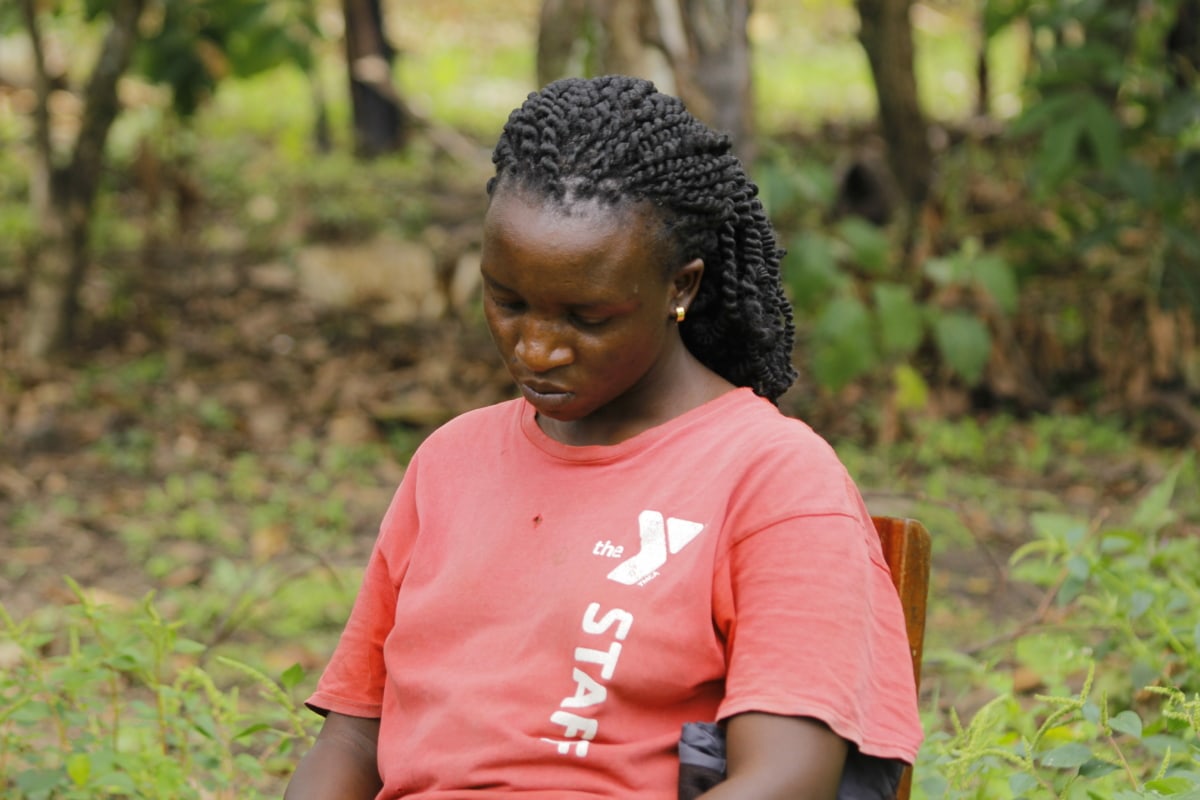
The two hydropower plants that make up the Nyamagasani Hydro Power Project are currently in operation and supply power to the national grid in Uganda.
Jessica Kabuhgo hopes that Frontier Energy will help her get a job. She was 19 when she was impregnated by an employee at the Nyamagasani Hydro Power Project.
“He had a lot of money and would give me between 20 and 50,000 shillings. But after I got pregnant, I could no longer get in touch with him. He has left town and his phone number no longer works,” she says.
Today, she lives at home with her parents, who help her take care of her daughter.
“My message to the company is that they make sure that we women get a job or some education so that we have a chance to create our own lives,” she says.
Frontier Energy did not wish to comment on Jessica Kabuhgo’s proposal. The company reiterates that they “cannot comment on the specific case out of consideration for those who have contacted them”.
Meanwhile, city council chairman Ivan Bwambale is trying to help the single mothers and their families in the best possible way. Through the local bishop, he has recently donated a herd of piglets.
“We need help to keep the mothers out of trouble now that there are no fathers to take care of them,” he says.
Frontier Energy’s subcontractor VS Hydro has not responded to Danwatch’s inquiries
We emit 25 per cent less CO2 per kilo of pork than we did in 2005.
The feat was repeated to the hilt when Danish Crown launched a campaign in 2020 with the slogan “Danish pork is more climate-friendly than you think.”
The 25 per cent was promoted in TV and radio commercials, in newspaper ads, on street signs and on the packaging of the pork itself. A small footnote on the website stated that the figure came from a report from Aarhus University.
See how Danish Crown uses the 25 per cent in a promotional video. Video: Danish Crown on Facebook
But now Danwatch and the Danish newspaper Politiken have revealed that Danish Crown, which commissioned and co-financed the report, has controlled the work of researchers at Aarhus University to a degree that, according to experts, violates the research principles of arm’s length and impartiality.
The revelation comes just weeks before Danish Crown is set to defend its campaign in the Western High Court, as the food giant has been sued for misleading marketing. The case is Denmark’s first greenwashing trial and is therefore considered to be a case of principle.
Apparently, Danish Crown is sitting at the table and decides how research should be conducted.
The experts’ opinions are based on emails and other documents sent between Aarhus University and Danish Crown, which Danwatch and Politiken have been given access to.
Heine Andersen, Professor of Sociology and expert in freedom of research, calls the report on which Danish Crown based its campaign “unreliable”.
“Researchers from Aarhus University should be in charge of the research. After all, they are the researchers. They have clearly not done that with this report. Here it is obviously Danish Crown that sits at the table, has provided data and calculations and decides how the results should be formulated,” says Heine Andersen, Professor Emeritus of Sociology at the University of Copenhagen.
Research ethics expert Claus Emmeche finds the material worrying.
“It should not be a case where a private actor or a lobby organisation has written a conclusion in advance and then uses university researchers to rubber-stamp it. You suspect this when you read the parties’ correspondence,” says Claus Emmeche, Associate Professor of Philosophy of Science at the University of Copenhagen.
Two selected responses from Danish Crown to Aarhus University.
From the very beginning, it was clear what Danish Crown wanted to get out of the collaboration with Aarhus University.
The correspondence about the report started in 2018, when Charlotte Thy, then environmental manager at Danish Crown, wrote an email to John Hermansen, a researcher in agriculture and the environment at Aarhus University.
He is also part of a research group that has previously been criticised for not being at arm’s length from the meat industry. We’ll come back to that.
Charlotte Thy writes that Danish Crown would like to have a life cycle assessment – or an LCA as it is called – of Danish pork. It is a method for calculating the carbon footprint of products. John Hermansen and his research group would like to do that, he replies.
Charlotte Thy suggests a meeting and points out what the report should be able to document:
“An outcome from the LCA should be a review of the results, as you did with the 13 types of beef, so that there is a basis for pointing out the advantages of pork on a documented basis.”
She refers to a previous report from 2015 by John Hermansen’s research group on the climate impact of different types of beef. It was the precursor to the “beef report”, also by Aarhus University, which was at the centre of one of the biggest research scandals of recent times. In 2021, the Attorney General’s Office concluded that Danish Crown must have co-authored both reports on beef due to the company’s involvement in the research itself.
“Here is finally our proposal for the calculations regarding the environmental profile of pork,” John Hermansen writes a few months after Danish Crown’s inquiry, and encloses a project description.
“As agreed, you just need to get started,” she replies. They agree on a price of DKK 30-40,000, but an actual contract is never drawn up.
Already in this initial phase, warning lights are clearly flashing, Heine Andersen points out. Firstly, it sounds as if the conclusion is written in advance when Charlotte Thy orders a LCA to document “the benefits of pork”, he says.
In addition, he points out that researchers should not send “proposals for calculations”, as they are the ones who should decide how the calculations should be designed. Last but not least, you should always ensure arm’s length in a contract.
“The fact that there is no contract that defines who is responsible for what and ensures independence and arm’s length disqualifies the report in advance,” says Heine Andersen.
However, it is in the period that follows that the whole thing becomes a case of pure confession, he adds.
It is absolutely ludicrous that the external party, with billions of Danish kroner at stake, can be allowed to go through the draft sentence by sentence and comment on every possible detail on almost every page.
The period otherwise starts with a good atmosphere between the parties. Danish Crown is excited about where the researchers’ work is heading. “It’s a fantastic development where you show great reductions,” Charlotte Thy praises.
However, after some corrections, the reductions will be slightly smaller, senior researcher Troels Kristensen from the research group explains. “This has meant some changes in both level and difference between the two years, but still with a significant reduction.”
“The difference is expected to be even greater when we also include the slaughterhouse part,” he adds.
“It’s still great, even if the number has shifted a bit,” Charlotte Thy replies.
However, the tone changes in November 2018, when Charlotte Thy reads what the researchers describe as “the final report”.
She thanks for the report, but notes: “There are a few things we need to get right before we are completely done.”
She then reminds them of the agreement with the project.
“Overall, we wanted to carry out this comparative life cycle assessment to be able to use it in marketing. The inspiration for this was taken from the beef project from 2015,” she writes, adding:
“The target group for the memorandum is thus communication professionals, salespeople and others who do not have a strong scientific background.”
She points out that she wants a meeting and that she has written a number of comments directly into the report, which she has attached.
In the document, Charlotte Thy has added 51 comments to different parts of the 28-page report. Most of the comments indicate that things should be changed. Figures and tables need to look different and parts of the text need to be changed.
For example, “Svin” (pig) should be changed to “gris” (pork) in the title – a change in wording that the Danish Agriculture & Food Council is also actively working to promote to improve the image of pork. She also prefers the term “miljøpåvirkning” (environmental impact) to “miljøbelastning” (environmental stress), she adds.
On the other hand, there are sections containing what she calls “environmental selling points”, which she would like to see more of: “Here we have some of the most important arguments that we need to use in marketing and further communication with our customers and other stakeholders. These scenarios and not least the choice of them should have a separate section and more information should be attached to them,” she writes.
She also writes in a comment that the environmental footprint of soy feed should not be included. It should be stated separately, she dictates. The lack of this item in the accounts was one of the experts’ points of criticism in the coverage of the beef report, as it represents a large part of the climate impact of food.
“If you don’t include it, you miss the most important aspect. Of course, you should include it to the best of your ability,” said Henrik Wenzel, professor at SDU and expert in life cycle analyses, on that occasion.
Documentation
Danish Crown added 51 comments on parts of the report after it was sent to the company by the researchers from Aarhus University. Here are some examples:


Heine Andersen strongly opposes the way Danish Crown is allowed into the control room.
“It is absolutely grotesque that the external party, who has billions of Danish kroner at stake, can be allowed to go through the draft sentence by sentence and comment on every possible detail on almost every page. It is completely unacceptable.”
The process is a breach of the arm’s length principle and thus the guidelines for good research practice, according to Professor of Law at SDU and expert in freedom of research, Sten Schaumburg-Müller.
“Of course, there may be some things that the requester (the person ordering the research, ed.) has an opinion about that is so minor that it doesn’t affect the arm’s length. But when it comes to the methodology or calculations themselves, the line has been crossed. And my assessment is that in this case, we are over the line.
This is backed up by Claus Emmeche.
“It is a breach of the arm’s length principle when researchers’ freedom to choose methods, calculation models and so on is not respected. And that seems to be the case here.”
Danish Crown begins communicating on the report’s findings in spring 2019 when the company publishes its climate targets. “Danish Crown has had researchers calculating and documenting the development since 2005. Therefore, it is now clear that the climate impact of producing one kilogram of pork has been reduced by 25 per cent,” the company writes, without mentioning that Aarhus University made the report.
In the fall, when Information’s uncovering of the beef report was in full swing, Danish Crown writes to the researchers that they would like to use the report despite what Information wrote. However, the parties may need to be more clear about their collaboration, Charlotte Thy notes:
“It has been decided to maintain that we will present the results from the comparative LCA you did for us. This means that we must also be able to present the memorandum.”
“In light of the pending beef case, the memorandum may need to be updated with a preface and a declaration to clarify what has been going on.”
The researchers therefore add the following about the collaboration:
“Danish Crown has provided editorial and comprehension comments, including the use of the term “grisekød” (pork) instead of “svinekød” (pig meat)”. Method selection, data processing and the final version of the report were made by employees at the Department of Agroecology, Aarhus University.”
However, this is not an adequate description, says Claus Emmeche.
“It sounds like a camouflage of what has actually happened. They could have written that Danish Crown has also been involved in interpreting data and results.”
Sten Schaumburg-Müller agrees.
“This is not a very precise way of describing what has happened. It should be mentioned that Danish Crown has been involved in both obtaining and assessing data.”
Danish Crown does not wish to be interviewed. The reason for this is that Charlotte Thy and her former managers no longer work at the company, press manager Jens Hansen writes.
However, Danish Crown acknowledges that the company has interfered too much in the creation of the pork report. Nevertheless, the conclusions of the report stand, Jens Hansen writes.
“We are fully aware that the process behind the creation of the concept paper and the written presentation of the project was criticisable. The important thing for us, however, is that the validity of the analyses, calculations and results in the report has not been questioned.”
Jørgen Eivind Olesen, Head of Institute, agrees to this.
Do you stand behind this report today?
“We are not behind the process, it is done in a different way today. In 2019, we did not have a quality management system, which the process around this report reflects,” says the head of department.
Not enough arm length?
“When the quality management system was introduced at the end of 2019, after this report was submitted, we changed the processes to better ensure arm’s length and to better declare the necessary communication and exchange of data between a researcher and a company. It has nothing to do with the research results. We stand fully behind them.”
Politiken and Danwatch have been in contact with Charlotte Thy, who no longer works at Danish Crown. She does not wish to comment.
Spy ships, nuclear submarines, landing ships and frigates. Danish Rockwool has systematically and deliberately supplied the Russian navy with hundreds of thousands of square meters of ship insulation used in some of the most advanced vessels in the Russian navy.
This is revealed by a comprehensive review of Russia’s official tender database, which Danwatch and Ekstra Bladet have conducted over several months.
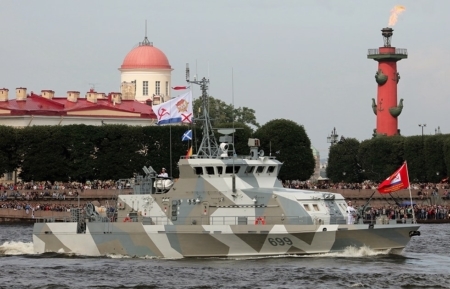
In total, there is evidence that since Russia’s illegal annexation of Crimea in 2014, Rockwool ship insulation has been sold at least 52 times to a total of 31 different vessels in Putin’s fleet. These include two destroyers, two submarines that can be equipped with nuclear weapons, two landing ships, three frigates, six minesweepers and five reconnaissance vessels – in other words, warships and spy ships at the very heavy end of the Russian naval arsenal.
Together, the list represents a sizable portion of Russia’s active fleet, which in July 2023 is estimated to consist of 297 warships, submarines and other military vessels.
In 29 of the cases, sales were made through Rockwool’s official partner and distributor, Marine Complex Systems LLC (MKS), a company that specialises in servicing the Russian military.
To better understand the type of vessels Rockwool has supplied insulation to, we asked Commander and Military Analyst at the Centre for Military Studies at the University of Copenhagen, Jens Wenzel Kristoffersen, to comment on their role in the Russian navy:


Destroyer, project 11551
“Admiral Chabanenko” (650) of the Northern Fleet
Destroyer, project 1155
“Marshall Shaposhnikov” (543) of the Pacific Fleet
Both are older destroyers, but still in active service. Also seen in the Baltic Sea. Used primarily as an anti-submarine vessel and is specially designed for this purpose.
Several of the ships have since played a role in the current war in Ukraine. This applies to the six ships belonging to the Black Sea Fleet, but for example, the landing ship “Pyotr Morgunov” from the Northern Fleet, to which MKS supplied Rockwool products worth 48 million rubles (approx. DKK 4.5 million at the time) in 2018, has also been directly involved in the war.
An EU regulation from March 2022 states that the 135-metre-long ship is equipped with an AK-630 cannon and heavy machine gun, among other things:
“The large landing ship “Pyotr Morgunov” project 11711, built by United Shipbuilding Corporation, participated in the illegal Russian invasion of Ukraine in 2022.”
Ukrainian military analyst Alexander Kovalenko also confirms to Danwatch and Ekstra Bladet that “Pyotr Morgunov” has played an important role during the war:
“It has been in the Black Sea since the beginning of the invasion of Ukraine. ‘Pyotr Morgunov’ has provided transportation of ammunition, personnel and equipment and has also participated in the mining of the Black Sea,” he says.


Landing ship, project 11711
“Ivan Gren” (010) of the Northern Fleet
“Pyotr Morgunov” (017) of the Northern Fleet
Capable Russian landing craft, the latest addition to the fleet. Kind of a hybrid between an amphibious and landing craft and an actual warship. Also seen in the Baltic Sea.
The market for selling insulation to warships is something of which the renowned Danish company has been fully aware. In an official promotional booklet from 2015, which Rockwool translated and distributed in Russia, highlights warships as one of the most common applications for Rockwool’s marine insulation.
Rockwool’s Head of Communications, Michael Zarin, writes in a response to Danwatch and Ekstra Bladet that they are aware that insulation products in “certain cases have been used in Russian naval vessels” and that they have been sold through the Russian subsidiaries’ external distributors.
“Neither ROCKWOOL A/S nor our Russian subsidiaries sell directly to Russian end users and nor do they have a customer relationship with the Russian military,” Michael Zarin writes, among other things.
Rockwool does not want to comment on why the company in Russia continues to work with MKS, which as a company is specialised in servicing the Russian navy. Neither do they want to answer questions about whether the group makes special demands on their distributors in Russia in relation to the end use of their products.

Nuclear-powered ballistic missile submarine, project 955A
“K-549 Prince Vladimir” (825) of the Northern Fleet
Largest, most dangerous and newest nuclear-powered submarine capable of carrying the latest “Baluva” ballistic missiles.
Dangerous in the North Atlantic if it escapes through the GIUK gap (the waters between Greenland, Iceland and the UK) undetected. Can launch its missiles from all areas of the globe and hit all Western targets.
According to Jens Wenzel Kristoffersen, a naval captain and military analyst at the Centre for Military Studies at the University of Copenhagen, the number of Russian naval ships with Rockwool is collectively capable of posing “a threat to allied forces at sea, on land and in the air.”
“The collection of ships is assessed to pose a military threat to allied naval vessels, including in relation to special operations, retrieval missions, monitoring, mapping of critical infrastructure and finally in crisis and war situations,” he says.
He particularly highlights the large ships such as the battlecruiser “Admiral Nakhimov” and the two destroyers “Marshal Shaposhnikov” and “Admiral Chabanenko”, all of which, despite being many years old, can still play a major role in future missions.
“Especially the larger units, regardless of age or whether they have undergone midlife updates, as well as the latest nuclear units, pose a particular threat in the Atlantic and to NATO allies,” says Jens Wenzel Kristoffersen.

Special-purpose nuclear-powered submarine, project 09852
“Belgorod” (BS-329) of GUGI, Northern Fleet
This unit forms the backbone of the Russians’ ability to conduct deep-sea operations (3000 – 6000 metres) with GUGI and specially equipped submarines. Its size indicates that it is best suited for special operations in the Atlantic and Pacific, but it cannot be ruled out that it has also been in the Baltic Sea.
Professor Michael Petersen, head of the Russia Maritime Studies Institute at the US Naval War College and a former member of both US military intelligence and the National Security Council, also believes that the many concrete warships are of great importance to Russia’s military.
He emphasises that Russia’s navy has undergone a large-scale modernisation in the years before and after the illegal annexation of Crimea in 2014, and according to him, Danwatch and Ekstra Bladet’s list of naval vessels insulated with Rockwool reflects exactly that development.
“The complete list provides an interesting and concrete insight into the Russian navy’s priorities for the construction and modernisation of surface ships. They reflect an emphasis on power projection, intelligence gathering and coastal defense,” he says.
“In particular, the construction of Project 22350 Gorshkov-class missile frigates is the primary focus in restoring the Russian surface fleet’s global presence and military power. They have carried out Russia’s highest-profile peacetime naval missions, including the first circumnavigation of the globe by a Russian warship since the nineteenth century in 2019.”


Frigate, project 22350
“Admiral Gorshkov” (417) of the Northern Fleet
“Admiral Kasatonov” (461) of the Northern Fleet
“Admiral Golovko” (456) of the Northern Fleet
Latest new line of frigates for the Russian navy. Extremely powerful unit designed for air defense, but also for launching various types of cruise missiles.
Heavily inspired by Western frigate design as a multirole frigate for use in all domains such as surface, air and anti-submarine warfare.
Whether it is equally good for all roles is questionable, but the air defense role seems strongest with its long range strike capability with cruise missiles as well as the latest hypersonic Tsirkon missiles.
Back in February this year, the Danish Business Authority initiated an investigation when Danwatch and Ekstra Bladet first revealed Rockwool’s connections to the Russian military.
At the time, it specifically concerned 5 ships equipped with Rockwool insulation, and the Danish Business Authority did not believe there was reason to assume that Rockwool had violated the EU sanctions introduced in connection with the annexation of Crimea.
Tara Van Ho, one of the world’s leading experts on human rights and business at Essex Law School in the UK, emphasises that even if companies are found not to have breached sanctions, they are still obliged to comply with the UN Guiding Principles on Business and Human Rights (UNGPs), which are designed to ensure that companies do not contribute to human rights abuses at any stage of their value chain.
“Rockwool has been behind a kind of systematic practice that is really worrying from a UNGP perspective. It suggests that there is a bigger problem with Rockwool’s screening processes,” she says.

Attack submarine, project 677
“Velikie Luki” (B-587) of the Northern Fleet
A dangerous little guy that is considered suitable for coastal operations.
The successor to the Kilo-class submarines, it is the latest diesel-electric type of submarine to be launched by the Russians. It can operate air-independently for up to 45 days, making it a particularly dangerous threat in the Baltic Sea, should it operate there.
Equipped with the latest versions of Kalibr cruise missiles, which we have seen used in the war in Ukraine.
“Many or all of these sales may be technically compliant with EU sanctions, but Rockwool was still supplying the Russian military through their official distributors with products necessary for the military’s activities.”
“As soon as Russia invaded Crimea, those sales should have been investigated more thoroughly – what we call enhanced human rights due diligence. That Rockwool continued to allow these sales raises the question of what they have done, and what they are doing now, to ensure that they are not complicit in Russia’s war crimes or crimes against humanity,” says Tara van Ho.
Fernanda Hopenhaym Cabrera, a member of the UN Working Group on Business and Human Rights, which helps implement and advise on the UNGPs, also emphasises that Rockwool is obliged to investigate its sales in Russia.
“Any company that supplies the arms sector with products or operates in areas of armed conflict should conduct enhanced due diligence”.

Frigate, project 11540
“Neustrashimy” (772) of the Baltic Fleet
An old lady in the arsenal. Once considered one of the biggest threats to submarines in the Baltic Sea. Today, it poses no major threat to modern submarines.
“Rockwool now has a responsibility to prevent, mitigate and address the potential or actual human rights violations caused by their business or commercial relationships,” says Fernanda Hopenhaym Cabrera and continues:
“This means that Rockwool has a responsibility to decide whether to implement direct preventive measures, withdraw from the region, abandon commercial relationships, or use its influence in the supply chain to prevent and address adverse human rights impacts, based on the results of its extended due diligence, of course.“

Battlecruiser, project 11442M
“Admiral Nakhimov” (080) of the Northern Fleet
The old Kirov-class in a new disguise. Will be equipped with the latest types of modern missiles, including the Tsirkon, which is a hypersonic missile, allowing it to pose a threat to even larger carrier groups in a Western context.
However, its age, despite the midlife update, means that as a unit it is not considered to be the most advanced but still the largest nuclear-powered surface unit the Russian navy has to offer. A presence in the North Atlantic will, nonetheless, mean that resources will need to be allocated to keep an eye on it in the event of a serious conflict.
Danwatch and Ekstra Bladet have asked Rockwool whether conditions have been imposed on the company’s Russian distributors – and whether the company itself believes that sales to the Russian military comply with the UNGP guidelines.
Michael Zarin, Head of Communications at Rockwool, declines to answer this question, but writes in an email:
“(…) As we have also previously stated, ROCKWOOL has extensive guidelines when it comes to risk assessments and due diligence.”
Despite repeated requests, Rockwool has not been willing to disclose the results of the risk assessments that the company has allegedly carried out in connection with their business in Russia.
One day, just before New Year, a ship registered under the Panamanian flag sailed up the Limfjord. The ship was carrying 77,447 tonnes of coal to keep the people of Northern Jutland warm through the winter.
The coal also held an important story about one of this year’s most powerful and controversial companies, a much-debated mine and a large group of people in Colombia who believe the coal is tainted by their blood.
In the spring of 2022, the coal was hastily ordered by Aalborg Forsyning. At the time, the Northern Jutlanders received all their coal from Russia, but the EU had banned such imports in the wake of Russia’s invasion of Ukraine.
As a result, Colombian coal, among other things, suddenly became popular again around the world after years of declining demand.
Last year, Aalborg Forsyning received a total of 125,000 tonnes from Colombia, 30,000 tonnes from the USA and 240,000 tonnes from South Africa to keep the people of Northern Jutland warm when winter returned.
One day in early December, the 77,447 tonnes of coal were shipped out of Puerto Bolivar on the La Guajira peninsula in northern Colombia. The small village was once populated by fishermen and farmers living off the lush nature, now everything is covered in coal dust and people have left.
Every day, trains arrive with 120 wagons loaded with coal from the famous Cerrejón mine 150 kilometres inland. Tens of thousands of tonnes of coal are unloaded into large bunkers at the port, from where it is loaded onto ships that sail to destinations all over the world, including Aalborg.
A few people have remained in the city. Among them is 52-year-old José Tomas Freile Gonzales, who Danwatch met in his home, where the furniture is covered in dust. He feels surrounded by the Cerrejón mine and its owner, multinational commodities trader Glencore, known for corruption and environmental destruction around the world:
“We are just watching the coal pass by here on the train. The coal, the dust pollutes us, kills us and dries us out,” says José Tomas Freile Gonzales.
He’s far from alone in those feelings.
In March this year, Danwatch went on a 10-day reporting trip to the area around the Cerrejón mine. And from here, the message is very clear: despite repeated promises from the mine’s owner, Glencore, and demands from customers and investors, nothing has changed.
The mine is still rumbling on and still making people sick, opponents are persecuted and the mine is an environmental disaster for the entire local area.
Few companies have a wilder and more scandalous history than Glencore. At the same time, hardly any company is more centrally positioned in this year’s energy crisis.
Glencore trades and produces everything from wheat to green minerals to coal. Some describe Glencore as a “vampire squid”, a squid that has wrapped itself around our entire civilization, ready to pounce on anything that smells like a good deal. The company’s tentacles extend far into our lives, and whether it’s your electric car, your smartphone or the heat in your radiator, there’s a good chance that Glencore made a profit from it before it got to you.
In 2022, Glencore entered into several large settlements, which in total meant that the company had to pay more than 11 billion Danish kroner for committing corruption and money laundering over many years. Nevertheless, 2022 was a record year for Glencore with earnings in excess of 230 billion kroner.
This can also be seen in the wealth of Glencore’s largest shareholder, 66-year-old South African Ivan Glasenberg, who has been involved in the company since 1984. According to Forbes’ 2023 report, he is worth 61.75 billion kroner.
As the world’s largest coal trader, Glencore and Glasenberg have benefited from the energy crisis, and as one of the largest suppliers of critical minerals, they are capitalising on the green transition. According to observers, Glencore has achieved this pivotal position in the global economy by being cynical and unafraid to cross the line.
Glencore was founded in 1974 by Belgian-born commodities trader Marc Rich, then known as Marc Rich + Co. AG. In the early years, the company made its money by trading oil with countries and people others wouldn’t trade: South Africa’s apartheid regime, Chile’s dictator Augusto Pinochet and a sanctions-hit Iran during the 1979 hostage crisis.
The company quickly became adept at tax evasion, sanctions avoidance and bribery. And by being in places where no one else would be – from DR Congo to Colombia – Glencore has gained access to resources and grown bigger than anyone else in their field.
For the first 37 years of its existence, Glencore enjoyed peace and quiet that comes with being headquartered in the Swiss town of Baar, where discretion is a virtue. For a long time, they were even nicknamed ‘the biggest company you’ve never heard of’. But when the company went public in 2011, they had to open up to their investors. Stories emerged that Glencore had traded with corrupt regimes; speculated on the price of grain while people in developing countries rioted for lack of food; and caused major environmental problems in African countries, such as acid rain in Zambia.
Since then, the scandals have abounded. Last year, when the Danish pension fund AkademikerPension had to explain why it would no longer invest in Glencore, it cited “allegations of corruption, poor working conditions, discrimination, child labour, forced displacement of local populations, excessive use of force, tax evasion and environmental pollution.”
So far, the scandals have culminated in the bribery cases that they settled last year.
Over a 10-year period, Glencore employees bribed the most powerful people in Nigeria, Cameroon, Ivory Coast, Equatorial Guinea, Brazil, Venezuela and DR Congo. Glencore flew money in suitcases to bribe judges and dictators. They have bribed their way to lucrative contracts and to the disappearance of lawsuits. As a US attorney general said last summer, the scale of bribery is “staggering”.
In one of the cases, investigators reviewed more than a million documents and found, among other things, that a commodities trader from Glencore’s West Africa division had withdrawn almost 50 million Danish kroner from Glencore’s cash desk at its headquarters in Switzerland and used it for bribery 25 times between 2012 and 2015. One of the directors who authorised the withdrawal of the money was responsible for business ethics.
No sooner had South Sudan gained independence in 2011 than Glencore was sending people on a private jet with 5.5 million kroner in bribes. Within days of the money landing in the right hands, Glencore’s fortune was made and they won a number of valuable contracts.
And so the list goes on.
In 2000, Glencore bought into the Cerrejón mine along with the two mining giants BHP and AngloAmerican, and in 2002 they took full control. The mining companies immediately began expanding the mine, encroaching further and further into the lands of the indigenous Wayuu people and Afro-Colombians, descendants of West African slaves who had come to the area in the 16th century.
The expansion was done in a way that the local population saw as destructive. Entire communities were forcibly relocated. Rivers that provided essential drinking water were diverted. And the people who didn’t move were contaminated with toxic heavy metals and coal dust from the mine. It’s still like that, the locals say.
In 2021, BHP and AngloAmerican sold their stake in the mine because, with climate change and the Paris Agreement in mind, they could not reconcile their businesses with being part of the mine. Glencore bought it all, became the sole owner of Cerrejón and promised to be a “responsible administrator”. Yet among workers in the mine and the communities surrounding the mine, Glencore is far from being perceived as responsible.
Today, the mine is the largest of its kind in Latin America and one of the largest in the world, with almost 70,000 hectares and 5,000 employees. That’s the equivalent of almost 100,000 dry, dusty football fields, filled with machines and trucks that emit a constant noise to the surrounding world. An area that has slowly eaten into its surroundings, turning it into a place where life doesn’t stand a chance. Everything takes place behind large fences; the mine is off-limits to outsiders.
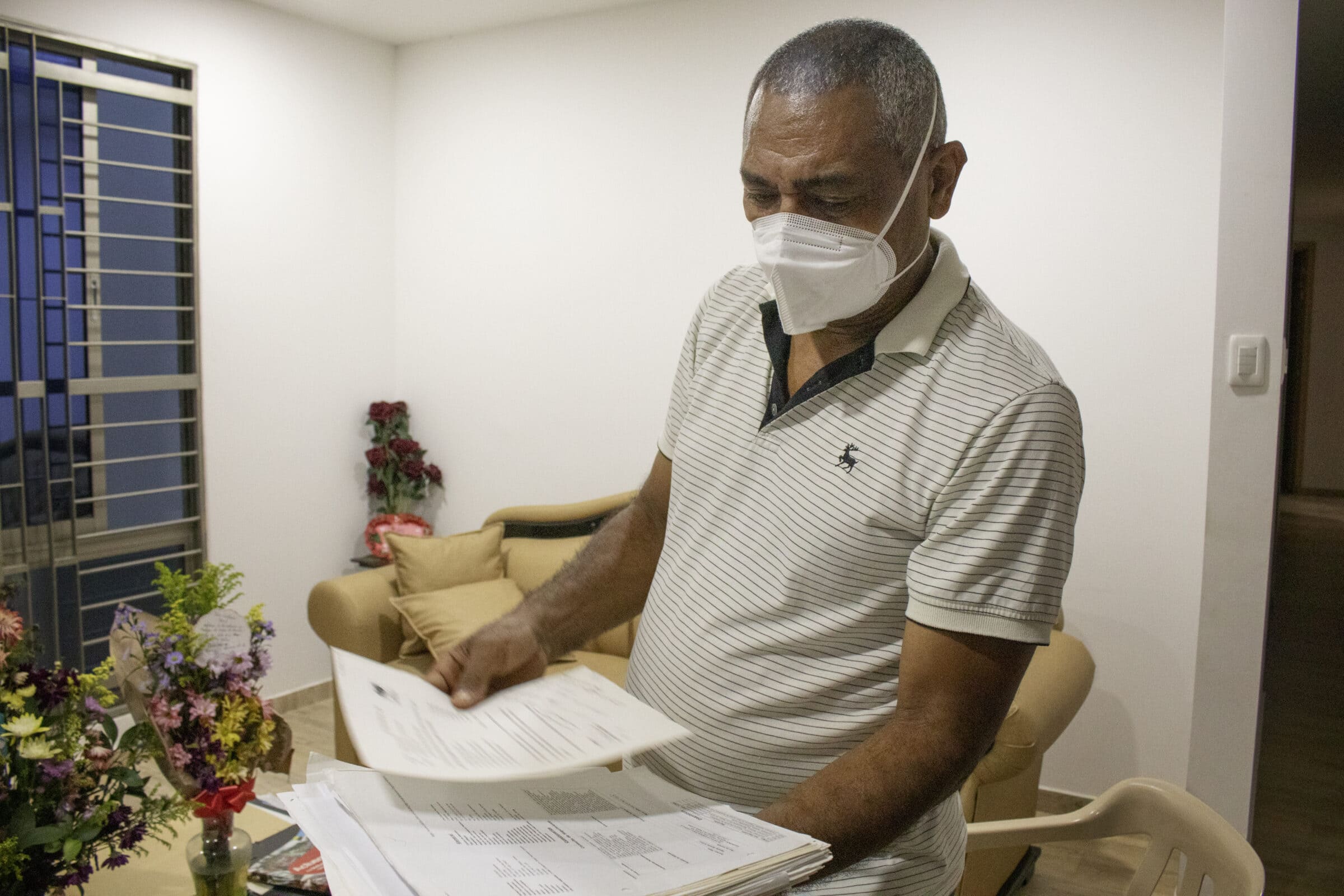
One of those who has experienced the mine from the inside is Jelix Enrique Torres Bolivar, who we meet in the mining town of Fonseca, under a tree in the courtyard of the Sintracarbón coal miners’ union. For two decades, he breathed in the dust of the coal mine.
“If I had known what mining was, I would never have worked in a mine,” he says through the face mask that covers his nose and mouth:
“It is harmful to health, to the respiratory system, to the skin, to the musculoskeletal system. Today I am a patient, I suffer from everything.”
Jelix Enrique Torres Bolivar is the first Cerrejón mine worker to have it recognised that the dust in the mine destroyed his lungs and gave him silicosis, also known as black lung.
However, he is just one of many miners whose health has been destroyed in the mine, says José Brito, who has been health secretary of the Sintracarbón union for 15 years and has been a member of the National Council for Occupational Risks.
“I know that people are working with a very dangerous material in Cerrejón. With the help of the union, we managed to discover more than 1,500 examples of workers who have fallen ill from working in Cerrejón, some of them with carcinogenic diseases. People suffer a lot from gastritis, irritable bowel syndrome, insomnia problems and psychological problems,” says the former union leader.
Near the small village of El Rocio, the Cerrejón mine is also intruding. The town is located on the banks of Bruno River, which Glencore and the Cerrejón mine want to divert because there are large coal reserves underneath.
If that happens, it would be catastrophic for the indigenous Wayuu people who live in El Rocio and other villages along the river.
According to a 2017 court ruling, at least 30 Wayuu villages depend on water from the Bruno watercourse. And the diversion now planned by Cerrejón will directly affect the water supply for a population of more than 200,000 people. At the same time, it threatens key parts of the Wayuu people’s culture, where water is connected to their spirits and spirituality.
However, Glencore is far from accepting the decision of the Constitutional Court and the protection of Bruno. Glencore has sued the Colombian state over the decision not to allow coal mining under the Bruno, claiming that the court’s decision was discriminatory, unfair and arbitrary and denied them “fair and equitable treatment”.
And the Bruno is just the latest example. Over the years, Cerrejón has diverted at least 17 rivers to extract coal. But the Wayuu people have also succeeded in preventing diversions. 57-year-old Leobardo Sierra, who we met in El Rocio, hopes to succeed again.
“On the one hand, I feel calm because I’ve been fighting. But it’s exhausting. I also see that there is hope, that dreams can come true. We also don’t want them to continue destroying or killing streams or depriving people of their territory.”
Danwatch and El Turbión, the Colombian media outlet we have been working with, tried to get a comment from Glencore through the press department at its headquarters in Switzerland. However, the press department never returned.
Glencore’s Chairman of the Board Kalidas Madhavpeddi could not hide from the criticism during Glencore’s annual general meeting on 26 May in Zug, Switzerland, where El Turbión was present.
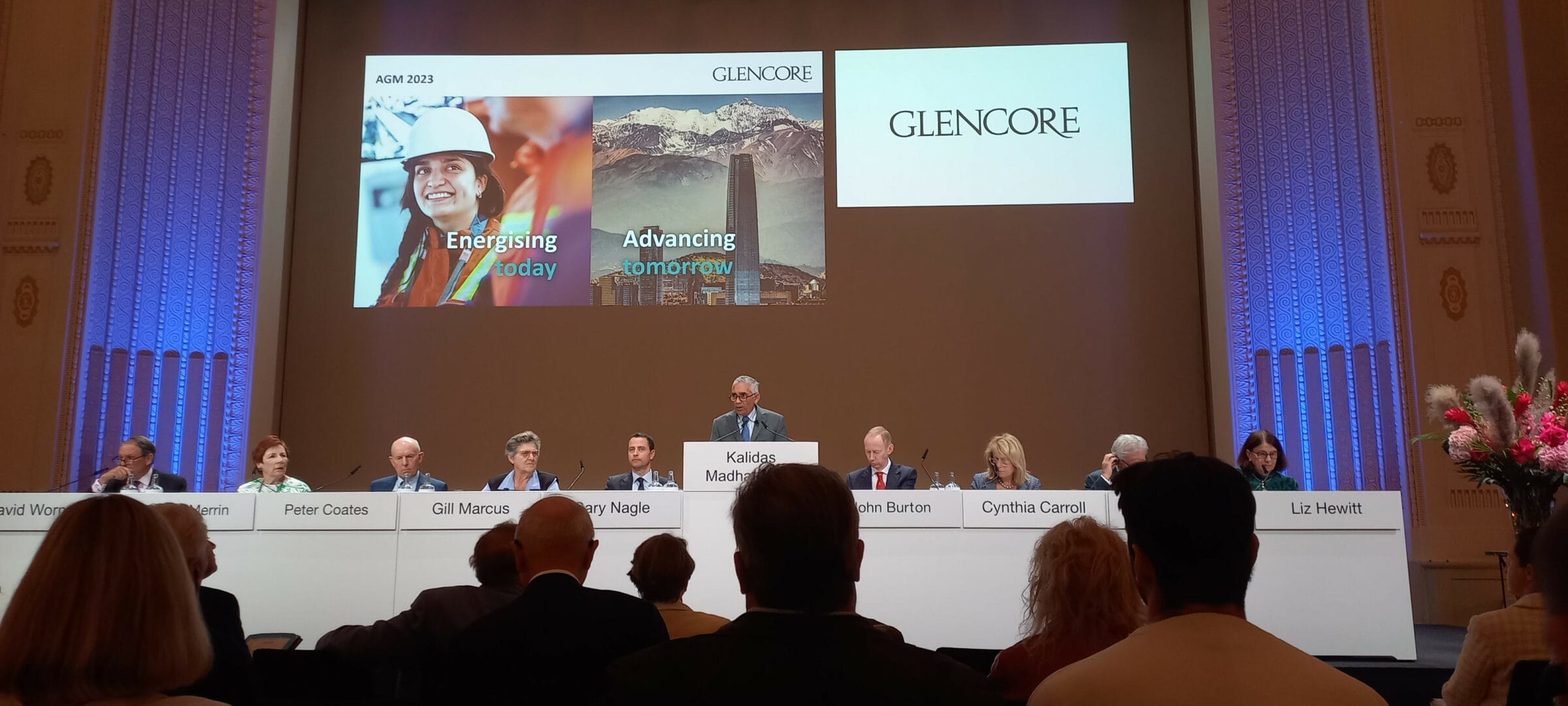
Here, Kalidas Madhavpeddi started by praising Glencore’s CRS policies:
“Wherever we operate, we are committed to placing a high value on doing so in an ethical and sustainable way. We employ 10,000s of people, support local businesses and service providers, and invest in local education, healthcare and infrastructure.”
Kalidas Madhavpeddi probably didn’t expect that the NGO Yukpa Solidarity Network had flown in a local indigenous woman who had experienced Glencore’s fatal devastation of the population in the Becerril and La Jagua de Ibirico regions of Colombia.
Just over an hour into the general meeting, she took the floor:
“I am a Yukpa woman from an indigenous reserve where Glencore has established itself, and I have seen the transformation and pollution of the environment that is causing the deaths of children. More than 40 children have died in our territory caused by pollution from open pit mining,” she says.
Kalidas Madhavpeddi then answered briefly:
“From our perspective, we do everything we can in terms of operations in our facilities. I’m not aware of that development.”
Danwatch and El Turbión have also posed a number of questions to Glencore through the local administration directly at the Cerrejón mine in Colombia.
In an email response, the mine’s ESG manager, Inés Elvira Andrade, primarily refers to Glencore’s website for answers to questions related to the company’s past corruption cases.
In response to the allegations of air pollution, sick employees, threats against critics and the diversion of watercourses, Inés Elvira Andrade denies that Glencore in Cerrejón has failed to live up to its responsibilities.
“Cerrejón’s commitments in La Guajira extend far beyond the investment, the payment of taxes and the creation of quality jobs. We strive to apply the highest standards of ethics and respect in our relationships with all our stakeholders. Similarly, we are committed to developing our operations in an environmentally responsible way and leaving a natural legacy for future generations,” she explains.
“We act on the principle of continuous improvement to strengthen our human rights due diligence processes. For this reason, we comply with various international standards and our human rights policy is in line with the UN Guiding Principles on Business and Human Rights.”
Read the full answer at the bottom of the article or click here to go straight the answer.
Danwatch first visited the Cerrejón mine in the autumn of 2009, when a quarter of the Danish coal consumption came from the mine.
Many of the problems were the same then as they are now. Forced relocations, pollution and sick coal workers. The stories in 2010 caused most Danish power plants to stop buying coal from Cerrejón.
Over the following 13 years, there have been several critical stories about the conditions in Cerrejón in both Danish and international media. Despite this and Glencore’s controversial reputation, Aalborg Forsyning chose to buy coal from Cerrejón in the spring of 2022.
When Danwatch spoke for the first time last summer with Per Clausen (EL), chairman of the board of Aalborg Forsyning and Nordjyllandsværket, about the conditions in and around Cerrejón, he reacted with surprise and a guarantee to initiate a dialogue with Glencore.
Danwatch has now confronted Per Clausen with the fact that conditions in Cerrejón are still horrible. In a written response, the chairman of the board maintains that Nordjyllandsværket has not entered into any new contracts with Glencore since the 77,447 tonnes of coal that arrived in December.
In addition, Per Clausen explains that they are in an ongoing dialogue with Glencore and have, among other things, presented the articles that Danwatch wrote last year about the mine’s negative impact on the local area.
“Aalborg Forsyning has been and is still in an ongoing dialogue with Glencore about our CSR requirements. With regard to the specific criticism from Danwatch about negative environmental impacts, Glencore has communicated in detail about a due diligence effort with a system for monitoring and measuring the effectiveness of the effort.
“Furthermore, Glencore has confirmed that it implements all elements of the OECD Guidelines for Multinational Enterprises and the UN Guiding Principles on Human Rights. Aalborg Forsyning has also shared its own impact assessments with Glencore, so they know the minimum level of information we expect to receive.”
Per Clausen will now consider the new information provided by Danwatch, but does not want to rule out doing business with Glencore again.
“We find that it is useful to make demands on Glencore and to follow up, and we will continue to do so. We believe that Glencore is one of the suppliers we can choose in terms of CSR, and therefore, also for security of supply reasons, we will not rule out buying coal from them again at some point.”
“We will include the statements you have made from your field trip in our further work and compare them with the other information we have.”
Shortly before this story is due to be published, chaos ensues at El Turbión.
El Turbión has been threatened and is in the process of clarifying whether this has anything to do with their investigation of the Cerrejón mine and Glencore.
Everyone we speak to in Colombia who has been fighting against the mine and Glencore has been threatened or harassed. None of them can prove that this comes directly from Glencore, but in the past Glencore has been criticised for its close ties to the country’s paramilitary movements.
In 2014, for example, the peace movement PAX presented testimonies from employees of one of Glencore’s subsidiaries explaining how they had helped fund the paramilitary group Juan Andrés Álvarez Front.
Samuel Arregoces is one of those who has felt the threats. He is an activist and comes from a town that has been cleared to make way for the Cerrejón mine.
For a number of years he has been fighting against the mine, but along the way he has had to go into hiding elsewhere in Colombia when the threats to his family became too intense.
A few days after we interviewed Samuel Arregoces, he suddenly writes. He was driving with another journalist and his security guard when a motorcycle pulled up alongside the car. When Samuel Arregoces looked out the window, he saw that the motorcyclist was wearing a balaclava. He instinctively hit the accelerator to get away, but the motorcycle followed him for several kilometres until they approached a police checkpoint.
Samuel Arregoces doesn’t know who the man was, but he knows for sure why he was there.
“There is no doubt that it is related to my activism against Cerrejón and against coal mining, and we are in the middle of a tough fight to defend the Bruno watercourse. This is what I do and I have no other enemies,” he explains.
Off the coast of Syria and near Norway’s border in the Arctic sail three frigates that are of utmost importance to Russia’s maritime power.
The frigates belong to the Admiral Gorshkov class, which are renowned and highly advanced ships in the Russian Navy. Equipped with Russia’s new Zircon hypersonic cruise missiles, they have the capability to strike targets up to 1,000 kilometers away.
Based on official documents that Danwatch and Ekstra Bladet have obtained, we can now reveal that these frigates are built using products from the Danish Rockwool Group.
For the past months Danwatch and Ekstra Bladet have covered how large parts of the Russian Navy is insulated with Rockwool. These three frigates represent the most significant, prestigious, and crucial Russian project that is known to have used Rockwool thus far.
According to military analyst Anders Puck Nielsen from the Danish Defense Academy, the frigates play a vital role in Putin’s military strategy.
“They hold immense importance for Russia’s navy as they enable operations over great distances. The frigates possess substantial firepower, allowing them to engage other ships and even carry out land bombardments,” he explains.
Rockwool itself does not directly sell its products to end customers in the Russian market but relies on a network of distributors. Particularly one of these officially certified partners, a company called Marine Complex Systems LLC (“MKS”), is responsible for a significant portion of the deliveries of Rockwool to the Russian Navy, including those used for the frigates.
MKS, a Russian company with more than 150 employees, specializes in work on military ships for the Russian Ministry of Defense. It has military approval and is certified by the FSB to handle state secrets. And since at least 2013 it has been a regular distributor for Rockwool, supplying the Russian Navy with Rockwool products worth at least 100 million rubles.
For the frigates, the first deal occurred in October 2013, when MKS agreed to supply more than 3,000 square meters of Rockwool insulation to the Severnaya Verf shipyard. According to the documents, this stone wool insulation was specifically intended for the lead ship of the series, “Admiral Gorshkov.”
In August 2015, a year after Russia’s illegal annexation of Crimea, MKS once again provided Rockwool insulation to Severnaya Verf. This involved two contracts, totaling 19,200 square meters of insulation for the subsequent ships in the series, namely “Admiral Kasatonov” and “Admiral Golovko.”
Overall, the three Rockwool contracts had a value of more than 12.1 million rubles, equivalent to over 1.5 million Danish kroner at the time.


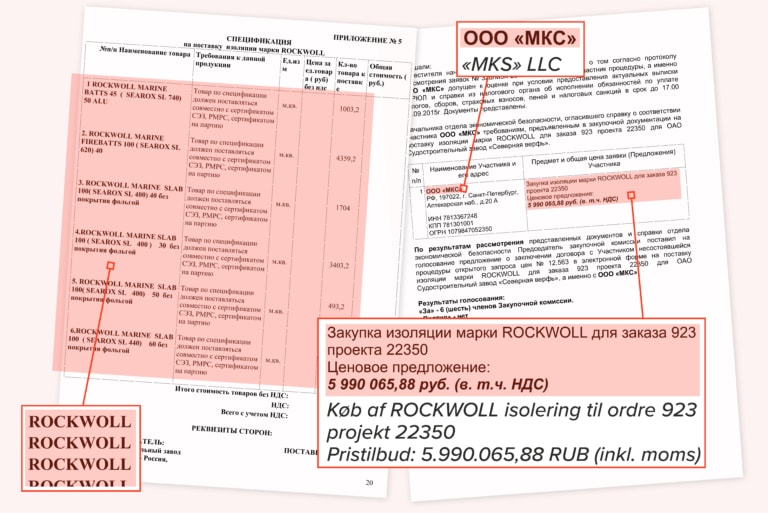
Despite numerous inquiries from Danwatch and Ekstra Bladet, Rockwool has declined to be interviewed about how their materials ended up in the three frigates. Instead, we have sent a number of written questions to Rockwool’s Danish headquarters concerning the transactions and the cooperation with the distributor MKS.
However, Rockwool Group’s head of communications, Michael Zarin, chose to ignore these questions and instead provided a general statement about Rockwool’s continuing presence in Russia, which he had also previously sent us. He further writes:
“Through distributors, our products are widely available on the Russian market, as is the case in many other markets. Neither ROCKWOOL A/S nor our Russian subsidiaries directly sell to Russian end users or have a customer relationship with the Russian military.”
“At ROCKWOOL, we typically do not comment on the specific details you have inquired about regarding particular projects or customer relationships. However, as we have previously mentioned, ROCKWOOL maintains comprehensive guidelines for risk assessments and due diligence.”
Michael Zarin did not disclose what specific kind of risk assessment Rockwool has conducted in relation to the deliveries to the Russian military, nor did he explain why Rockwool continued its cooperation with MKS for several years despite MKS’ regular deliveries to the Russian military.
Rockwool’s factories in Russia are not directly subject to EU laws and sanctions. Nonetheless, Rockwool is committed to adhering to the UN Guidelines on Business and Human Rights (UNGPs), which require companies to ensure that they do not contribute to human rights violations at any stage of their value chain.
In collaboration with Ekstra Bladet, Danwatch has uncovered a systematic use of Rockwool for insulating ships for Russia’s Ministry of Defence. The investigation has so far identified the following projects:
Furthermore, the leading Danish stone wool producer has supplied insulation materials for use in the Russian Ministry of Defense headquarters in Moscow, the naval headquarters in St. Petersburg, and the Ministry of Foreign Affairs head office in Moscow.
Fernanda Hopenhaym Cabrera is a member of the UN Working Group on Business and Human Rights which works towards implementing and advising on the UNGPs. She believes that Rockwool bears responsibility for the fact that its products are now installed in three active frigates in Russia’s navy.
“If their subsidiary in Russia sells to distributors who then sell to the Russian military, then Rockwool naturally has a responsibility over the entire value chain. They can’t just say that they didn’t know,” says Hopenhaym Cabrera.
The UN guidelines are applicable to all companies, irrespective of whether they choose to acknowledge them or not. However, companies like Rockwool, which publicly commit to complying with the UNGPs, are expected to uphold those commitments, according to Hopenhaym Cabrera.
“A company that has a human rights policy and publicly commits to the UNGPs should have mechanisms in place to ensure that its products do not end up contributing to human rights violations,” she emphasizes.
Hopenhaym Cabrera points to the fact that two of the deliveries occurred after Russia’s illegal annexation of Crimea in 2014, a period marked by Russia’s military aggression and well-documented human rights violations. Under such circumstances, companies are expected to conduct enhanced due diligence for their business operations.
“It appears that Rockwool, in this instance, has not carried out this enhanced due diligence for their entire value chain and business partners. If they want to have operations that are human rights respecting and to comply with their human rights responsibilities, they should have taken greater action in this type of setting”.
In addition to the three frigates that are built already, the shipyard Severnaya Verf is currently constructing five more frigates of the same type. Furthermore, they have signed contracts with the Russian Ministry of Defense for two additional frigates.
This suggests that there may be more contracts involving Rockwool than the three that are known to Danwatch and Ekstra Bladet.
We have reached out to Severnaya Verf for a comment regarding their use of Rockwool for warships, but they have not returned our emails. However, in a 2020 article published by the Russian military publication Mil.Press, the shipyard’s press department confirmed the utilization of Rockwool in frigates:
“For corvettes, we purchase insulation from the company Tizol, and for frigates – from Rockwool”.
The press department further added, “Rockwool initially had supplies from Finland, but now the Rockwool factory operates in Vyborg. The quality of products from these companies meets the requirements of the supervisory authorities and our customer.”
We have also reached out to Rockwool’s distributor Marine Complex Systems LLC (“MKS”), but they did not respond to our request for comment.
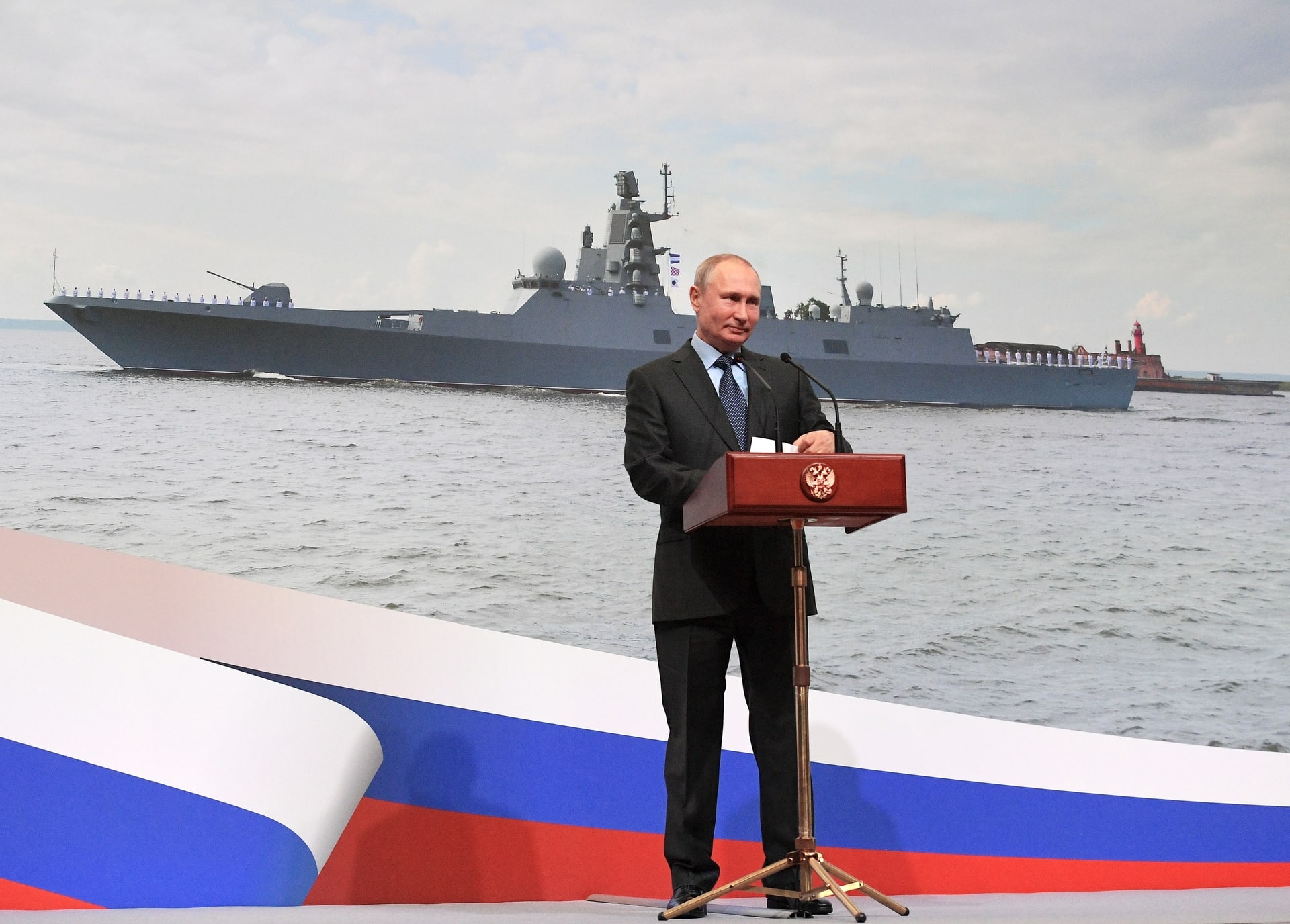
The Russian Navy’s latest frigates has captured both international and domestic attention, making headlines worldwide.
The Admiral Gorshkov series of frigates, measuring 135 meters in length, boast a top speed of 29.5 knots and are equipped with an array of weaponry, including Kalibr cruise missiles, anti-aircraft guns, anti-submarine weapons, and the A-192M artillery system.
Notably, these frigates also feature Russia’s latest hypersonic Zircon missiles, capable of striking targets up to 1,000 kilometers away.
During a ceremony in January of this year, President Putin praised the frigates, particularly the inclusion of the Zircon missiles, as the frigate “Admiral Gorshkov” was commissioned into active combat duty.
“It [the Zircon missile] has no analogue in any country in the world. I know that such powerful weapons will make it possible to reliably defend Russia from potential external threats and will help ensure our national interests,” remarked President Putin.
The following video, sourced from Russia’s Ministry of Defense, showcases the “Admiral Gorshkov” conducting artillery fire against a naval target in the Atlantic Ocean in February 2023.
According to plan, “Admiral Gorshkov” will embark on an extensive voyage across the Atlantic Ocean, the Indian Ocean, and the Mediterranean. The vessel is fully prepared for combat, as confirmed by Commander Ivan Krokhmal, who reported to President Putin during the ceremony in January.
Krokhmal stated that the ship was “equipped with ammunition for the missiles in the Zircon and Caliber systems, air defence systems, torpedo weapons, and artillery. The crew of the ship is ready to carry out the tasks of combat duty.”
Recently, satellite images captured “Admiral Gorshkov” at the Russian naval base in Tartus, a port city in Syria, on April 29.
According to Russian news agency Tass, the “Admiral Gorshkov”, which can accommodate a crew of up to 210, will be patrolling the Mediterranean during May and June. Afterward, it will return to Russia’s Northern Fleet based in Murmansk, near the Arctic border with Norway.
Military analyst Anders Puck Nielsen from the Danish Defense Academy assesses that this strategy aligns with the Russian navy’s objectives.
“These ships enable them to operate over great distances. Unlike small corvettes confined to naval bases, frigates like these can be deployed worldwide. Russia has utilized this capability for long voyages to regions such as the Mediterranean and the Indian Ocean. These frigates possess the endurance and long-range missile capabilities to cover vast areas. As a result, they pose a threat from considerable distances and bring substantial firepower to the battlefield,” he says.
The second frigate in the series, “Admiral Kasatonov,” which was commissioned in 2020, has also attracted significant attention in the media.
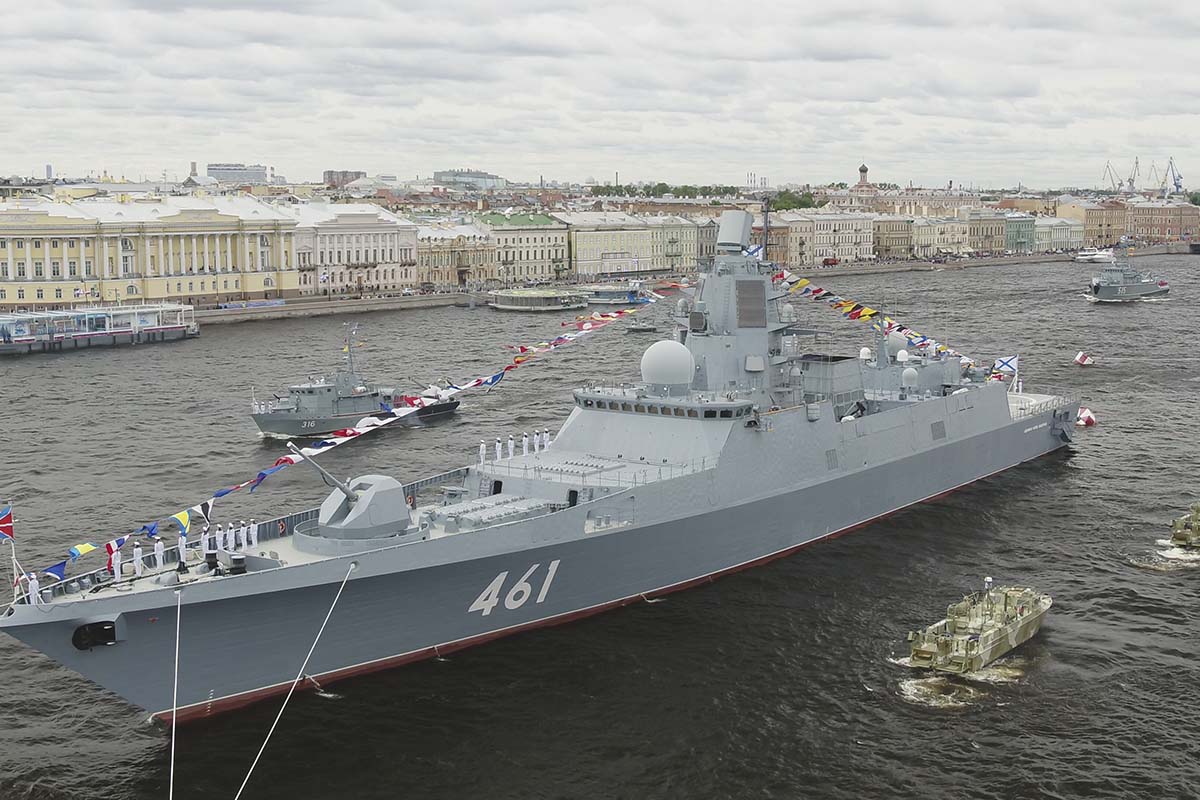
In March 2023, the frigate returned to the Northern Fleet base in Severomorsk after an unprecedented journey lasting over 420 days. Remarkably, the frigate had covered a distance equivalent to circling the world three times.
During its return voyage to Severomorsk, the “Admiral Kasatonov” attracted the attention of the Spanish, Dutch, and English fleets, who closely monitored the frigate’s passage through their respective waters.
In Severomorsk, the “Admiral Kasatonov” will be joined by the third frigate in the series, the “Admiral Golovko.” The Russian Ministry of Defense reports that “Admiral Golovko” is currently undergoing final tests at the Russian Navy’s combat training ranges in the Barents Sea. Following the completion of these tests, it is scheduled to officially join the Northern Fleet in June.
Apart from the three completed frigates already mentioned, the Severnaya Verf shipyard is actively engaged in the construction of five additional frigates of the same type.
These forthcoming vessels bear the names “Admiral Isakov,” “Admiral Amelko,” “Admiral Chichagov,” “Admiral Yumashev,” and “Admiral Spiridonov.”
Furthermore, Severnaya Verf has secured a contract for two more frigates named “Admiral Kapitanets” and “Admiral Vysotsky.”
In April 2019, Vladimir Putin personally visited the shipyard to commemorate the keel-laying ceremony for two of the under-construction frigates, “Admiral Amelko” and “Admiral Chichagov.”
In spring, two Greenlandic officials from the Ministry of Mineral Resources in Nuuk traveled to Copenhagen. They knew that they were due to appear before the Court of Arbitration, but they did not anticipate what awaited them in the court room located in a glass building overlooking the Langelinie promenade in Copenhagen.
They were met with seventeen lawyers, each representing an international mining company.
The lawyers were claiming damages that could topple Greenland’s economy and an ultimatum to the Cabinet of Greenland: either you give the green light to the controversial Kvanefjeld mining project in South Greenland, or you cough up money.
Danwatch, in collaboration with Politiken, can now disclose several new details in the Kvanefjeld case, which has major political implications and could ultimately leave Danish taxpayers with a huge bill.

For years, the mining company, Energy Transition Minerals, has been trying to get permission to extract critical minerals from Kvanefjeld, which boasts one of the largest deposits in the world.
But alongside the critical minerals, there are the radioactive substances uranium and thorium that could pose a risk to Greenlanders living near Kvanefjeld.
Therefore, with a new uranium law in hand, Greenland will soon reject the mining company’s application.
Energy Transition Minerals are aware of this, which is why they will counter with a claim for damages that could amount to 15 billion Danish kroner, which corresponds to at least three years of the block grant that Denmark gives Greenland.
But the case is about much more than the legal dispute between the mining company and the Cabinet of Greenland.
The critical minerals in Kvanefjeld are essential for a green energy transition and are at the center of a security race between the US and China, who are both lurking in the wings.
The case is shrouded in its own mystery.
Many sources have something to say about Kvanefjeld, but few will put it in writing.
To get the whole picture, we have to go back 70 years to the first pursuit for critical minerals in Greenland’s subsoil.
Hope and fear have encircled Kvanefjeld in South Greenland since the 1950s, when Niels Bohr first set foot on the mountain. It was the famous Danish nuclear physicist who discovered the minerals in the mountain and envisaged mining uranium for Danish nuclear power plants.
Even then, the inhabitants of the town of Narsaq, which lies at the foot of the mountain, feared the deadly contamination and radioactive irradiation, for the sake of their children and animals.

Deep in Kuannersuit, the Greenlandic name for Kvanefjeld, there is also one of the world’s largest deposits of critical minerals.
It is the mineral Steenstrupine, named after the Danish geologist K. J. V. Steenstrup, which is gaining interest because it contains fifteen of the critical minerals that are in short supply needed for the technology that will ensure the green energy transition.
But it is difficult to excavate these critical minerals without bringing uranium to the surface and exposing humans and animals to radiation hazards.

That is why it was controversial when the mining company, then called Greenland Minerals, was granted an exploration license for Kvanefjeld in 2007.
The geological surveys by the mining company were promising. In the mountain’s interior, the much sought-after minerals were found in large quantities. So were uranium and thorium.
And while the mining company saw big business in the mine, the radioactive substances caused fear among many Greenlanders, and a popular protest movement coalesced around the slogan ‘urani naamik’, no to uranium.
At the same time, the planned construction of the mine raised concerns among professionals. The mining company would dig a hole in the mountain top and dump the toxic and radioactive wastewater into a lake behind a dam at the top of the mountain.
If something went wrong, it could prove fatal for the town of Narsaq at the mountain’s foot. In the past, several similar dams have burst. Hundreds of lives were lost.
Nevertheless in 2021, the Greenlandic authorities gave the mining company’s environmental report the green light. The next step was to gain permission to extract 30,000 tons of critical minerals per year, for the next 37 years.
But then the proposed mine at Kvanefjeld was hit by another significant crisis. Policy.
The same spring that the mining company got the environmental report approved, Greenlanders went to the polls.
And the mining project was top of the agenda. In many places, posters displaying ‘urani naamik’ were alongside election posters. An opinion poll in South Greenland showed that 71% of the population were against the mining project.
In fear that the project will scare away tourists or become a health hazard to the local population. More than half of the citizens did not trust the authorities to manage the Kvanefjeld project.
A 34-year-old man who grew up in Narsaq overlooking Kvanefjeld led the political opposition to the mining project. His name is Múte B. Egede, a former Minister for Raw Materials, leader of the opposition party IA (Inuit Ataqatigiit) and a fierce opponent of the mining company. After the election, he became the prime minister of Greenland.
“The people have spoken and the people are right, the project will not happen”, Múte B. Egede announced shortly after the April 2021 elections.
Seven months later, Inatsisartut, the Parliament of Greenland, convened on a new law, which passed by a slim majority.
Politicians adopt the ban on uranium, a death sentence for the Kvanefjeld project. The path to critical minerals and uranium is definitively blocked by a five-paragraph law. The day after the election, Greenland Minerals’ shares fall by 44 percent.
Today, two years later, the project is in a strange kind of limbo. On one side of the conflict is an accountant, on the other a lawyer.
The accountant is Miles Guy, Chief Financial Officer of Energy Transition Minerals, formally Greenland Minerals. He has been involved since 2009 and he has seen several attempts to shut down the project. The Uranium Act is another setback in the fight for Kvanefjeld.
“They passed a law at the 11th hour to stop this project”, says Miles Guy about the uranium law.
But the mining company has not given up yet, and Miles Guy insists that they have complied with all the requirements set by the authorities.
“Our assessment is that we are entitled to an exploitation license, and that is the right we are trying to enforce. If it is proven that we are not entitled to it, our argument will be that we have been expropriated and are therefore entitled to compensation. But our primary goal is to enforce our right to an exploitation license,” he says, pointing a legal gun towards the government of Greenland and in part Denmark too, to which this case is also directed.
The lawyer is Jørgen Hammeken-Holm, who has just celebrated his 25th anniversary as a civil servant in the Greenlandic civil service.
As Permanent Secretary for Mineral Resources, he has seen politicians come and go over the years, and this is not the first time an Australian mining company has flexed its muscles in front of him and his small office.
“I sleep peacefully at night”, says Jørgen Hammeken-Holm.
He denies that the mining company has been expropriated.
Instead, he believes that the uranium law trumps the authorization previously granted and the new legislation is one that everyone must follow.
“Naalakkersuisut, the Cabinet of Greenland, decides on the grounds of the rules in force at any given time.
The Uranium Act specifies which licenses the Act applies to, and the Government of Greenland must, of course, follow those rules”, he says.
If Greenland and Denmark end up losing the case, Jørgen Hammeken-Holm does not belive that the two countries could be ordered to pay compensation.
Instead, he suspects that the judges will tell the Government of Greenland that it has interpreted the rules incorrectly.
Compensation is out of the question because, according to him, the law does not allow for expropriation.
“This means that the lawsuit has to begin from the point where it was last left off. In the worst case, we would start the lawsuit from where we left it and in doing so they can get an exploitation license,” says Jørgen Hammeken-Holm.
While Jørgen Hammeken-Holm is confident, experts warn that Greenland is gambling with its own future.
Poul Hauch Fenger is a lawyer with expertise in international law.
As a lawyer, he has had insight into several arbitration cases and believes that from the outside it seems as if Greenland has adopted the new uranium law in an attempt to stop the mining project in Kvanefjeld.
In his opinion, this creates a “Gordian knot” for Energy Transmission Minerals, because the mining project has been organized according to an existing legislation and is now suddenly presented with a completely new and stricter legislation.
“With the proviso that I do not know the finer details of the case, I would say that the existing legislation must be stronger than the new legislation. Therefore, my immediate thought would be that mining company has a good case”, he says, also issuing a warning to Greenland:
“When companies consider throwing millions or billions of dollars into a project, they do so based on the expectation that their investment will be returned. But if they can see that the political climate means that a new, blocking legislation can suddenly be adopted, they could find themselves on thin ice and become very reluctant to invest,” says Poul Hauch Fenger.
Former Deputy Director of the research institution GEUS (Geological Survey of Denmark and Greenland) Flemming Christiansen agrees.
He believes the case presents Greenland with a “credibility problem”.
“As a matter of principle, you don’t legislate retroactively, as I believe has happened here. Previously, it would have been the case that you would automatically get an exploitation license if you had first obtained an exploration license and at the same time met the requirements laid down,” says Flemming Christiansen.
He also believes that the lawsuit’s biggest loser will be the green energy transition.
“If people are going to have electric cars and wind turbines, then somewhere in the world mining must be carried out to get the metals we need,” he says, arguing that concerns about radiation could be addressed through various forms of environmental protection.
The easy alternative is for Greenland to allow the project to proceed in a form that is as safe as possible for everyday life around Kvanefjeld.
This will provide Greenland with jobs and large tax revenues, while making critical minerals available as soon as possible for the green energy transition.
And it would certainly avoid a potential bill of 15 billion Danish kroner.
But against this backdrop and with cryptic references, sources say that you have to look beyond Greenland to understand why the government of Greenland does not just take the easy way out.
You have to look to the east.
On a winter afternoon in 2019, a Chinese man takes the stage at a conference at Industriens Hus in Copenhagen and begins to speak.
The man’s name is Mr. Hu Zesong, and the Confederation of Danish Industries has invited him to talk about mining investments in Greenland.
Mr. Hu Zesong is the CEO of the Chinese company Shenghe Resources, one of China’s leading companies in the processing of critical minerals and uranium.
Mr. Hu Zesong is enthusiastic about the Kvanefjeld project in Greenland and about Energy Transition Minerals, of which Shenghe Resources owns 12.5 percent.
Chinese co-ownership has caused a stir in Greenland, particularly back in 2016 when it emerged that Shenghe Resources had the opportunity to buy 60 percent of shares in the mining company.
But Shenghe Resources are also interesting because they are partly owned by the Chinese state and are a crucial piece in China’s attempt to control the world’s critical minerals.
Until the Uranium Act, all indications were that when critical minerals were extracted from Kvanefjeld, they would be shipped to China, where Shenghe Resources, together with China National Nuclear Corporation (CNNC), would process them.
This in itself is controversial because the two Chinese companies agreed to import critical minerals into China, where they would be separated from the thorium and uranium, both of which can be used as radioactive fuel.
For example, in nuclear weapons.
The US authorities link the China National Nuclear Corporation to the Chinese military.
It is important to understand the role of Shenghe Resources because they are one of China’s key players in the great power struggle for critical minerals, and because it is a battle that is largely being played out on Greenland soil.
In 2019, the then US President, Donald Trump, even wanted to buy Greenland, while the then US Ambassador to Denmark Carla Sands participated in ceremonies and excursions to Kvanefjeld and the US opened an Arctic Embassy in Nuuk.
During a trip to South Greenland, the US Geological Survey determined that “one of the world’s largest reserves of critical minerals is found here”.
On the other hand, the US and China have been fighting over the rights to a mining project at Citronen Fjord in North Greenland.
Another Chinese company, General Nice, in 2015 bought a company that holds the rights to a large iron mine at Isua, not far from the capital, Nuuk.
The EU has opened an official office in Greenland as part of its new Arctic policy.
And the EU is very clear about the need to access Arctic resources, the vast majority of which are held by China.
While Greenland does not have a problem with Chinese investments, Danish and American politicians are quite nervous about them.
Recent threat assessments by the Danish Defense Intelligence Service (Forsvarets Efterretningstjeneste) state that the threat of espionage from China is increasing and commercial interests can lead to political influence. And most recently, last week PET warned of a massive and growing espionage threat from China.
In July 2021, Denmark adopted two laws to prevent foreign investments and economic agreements – mainly Russian and Chinese – from threatening Denmark’s national security.
The chair of the Foreign Affairs Committee, Michael Aastrup Jensen, urges Greenland and the Faroe Islands to implement the same type of laws.
The warnings were clear during the meeting at Parliament.
“We need to look at how we can have closer cooperation on critical infrastructure,” Aastrup Jensen told the Greenlandic and Faroese members for parliament.
In less than two months, the army of lawyers will meet again in the Copenhagen Arbitration Court.
Three judges have to decide whether the case should go to arbitration at all or be transferred to the ordinary courts.
In that case, the lawsuit is likely to be played out in the courts in Greenland until the dispute is settled.
The battle for Kvanefjeld continues.
On 8 August 2022, the day Israel concluded its latest three-day bombing operation in Gaza, the Israeli Air Force posted a video on Twitter:
A brand new F-35 slowly rolls out of a hangar before a group of pilots appear to receive a briefing from a superior. Their uniforms reveal that they are from Israel’s “Lions of the South” squadron, and from the sparse audio in the video, you can tell that the briefing is about “combat action”. In the video, the fighter’s bomb bay is open, and at the end we see a series of bombs being prepared before an anonymous F-35 pilot dons his flight suit.
As Danwatch, Information and Lighthouse Reports have documented, Israeli F-35s, which contain a number of crucial Danish components from, among others, the Danish company Terma, took part in operations in Gaza in 2021 and 2022. Here, 75 children were killed and human rights organisations claim that Israel committed possible war crimes.
We have now taken a closer look at the bombs that appear to be loaded into the Danish-equipped aircraft. And we can document that these are the heavy GBU-31s, which are some of the most controversial bombs used by the Israeli military in Gaza.
At almost 1,000 kg, the GBU-31 is one of the heaviest bombs in the Israeli military’s active arsenal, and according to the International Red Cross, the bomb is so powerful that it should not be used in urban areas.
A UN Human Rights Council commission report cites engineers and arms designers that the blast wave from a GBU-31 “can rupture lungs and sinuses and tear off limbs hundreds of feet (30-90 metres) from the blast site.”
“When it hits, it generates [GBU-31] an 8,500-degree fireball, carving a 20-foot crater while displacing 10,000 pounds of dirt and rock and generating enough wind to knock down walls several blocks away and throw metal fragments a mile (1.6 kilometres ed.) or more,” the commission continues.
Yet Israel has regularly dropped bombs in Gaza, one of the world’s most densely populated areas with over 2 million inhabitants in an area the size of Langeland.
Over the past few years, GBU-31 has on several occasions caused entire residential complexes in Gaza to collapse, resulting in many civilian casualties. Amnesty International and Human Rights Watch have for years criticised Israel’s use of the GBU-31 bombs in Gaza and consider several of the bombings to be war crimes.
In 2015, the UN Commission assessed that Israel’s military risks violating the laws of war as soon as it uses the bomb in populated areas of Gaza: “Attacks using this type of arms in densely populated, built-up areas of Gaza would (…) likely constitute a violation of the prohibition on indiscriminate attacks,” the Commission wrote in its report to the UN Human Rights Council.
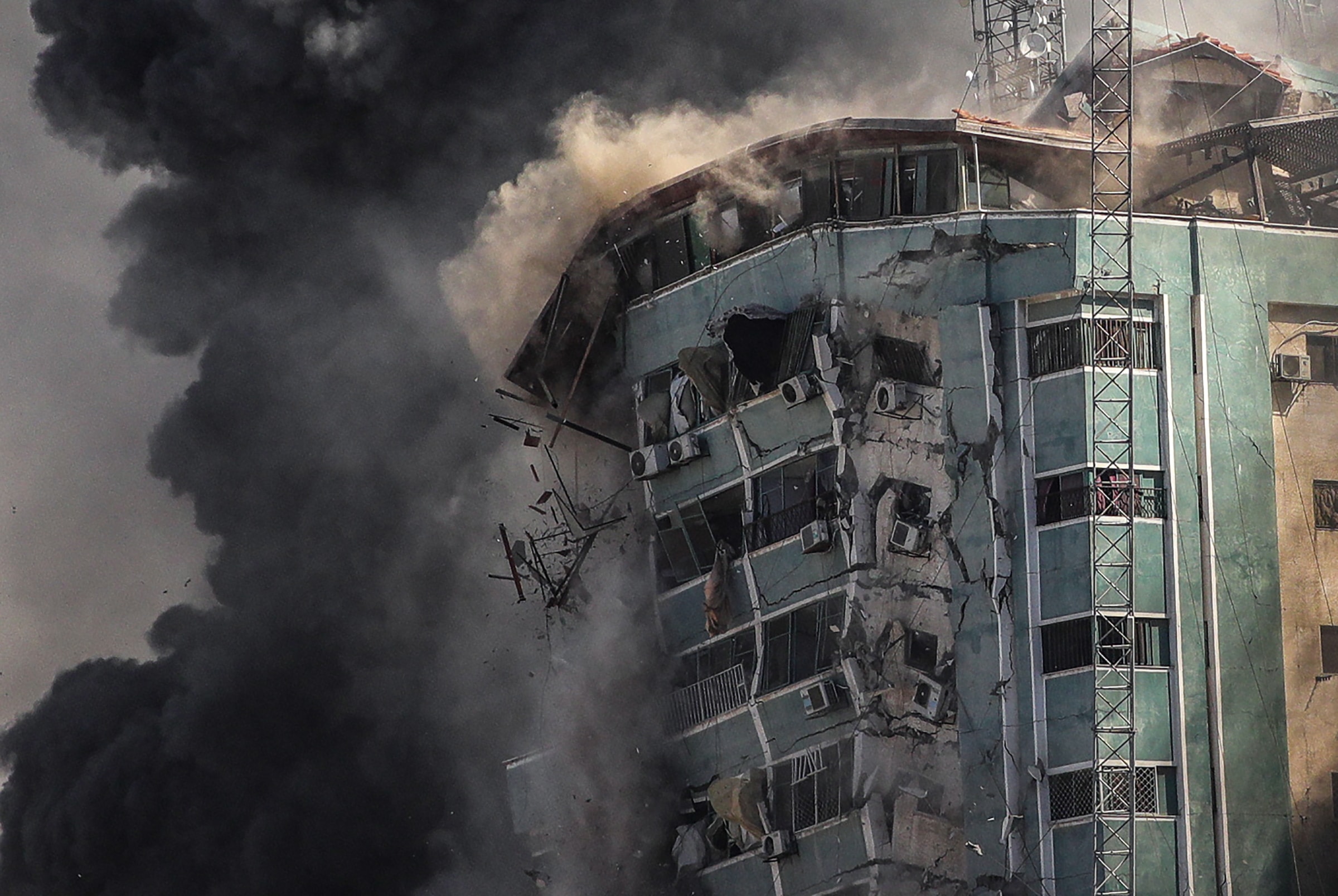
The manufacturer of the F-35 fighter aircraft, Lockheed Martin, states that the F-35A, which is Israel’s version of an F-35, keeps two GBU-31 bombs in its internal cargo hold as its “standard internal arms load”. And the Israeli Air Force website that the F-35 can hold two GBU-31 bombs as its “standard configuration”.
Danwatch and Information have found that the same type of bomb seen in the August video appears in other of Israeli F-35s. And we have gone through a long technical process to identify whether these are the heavy GBU-31 bombs.
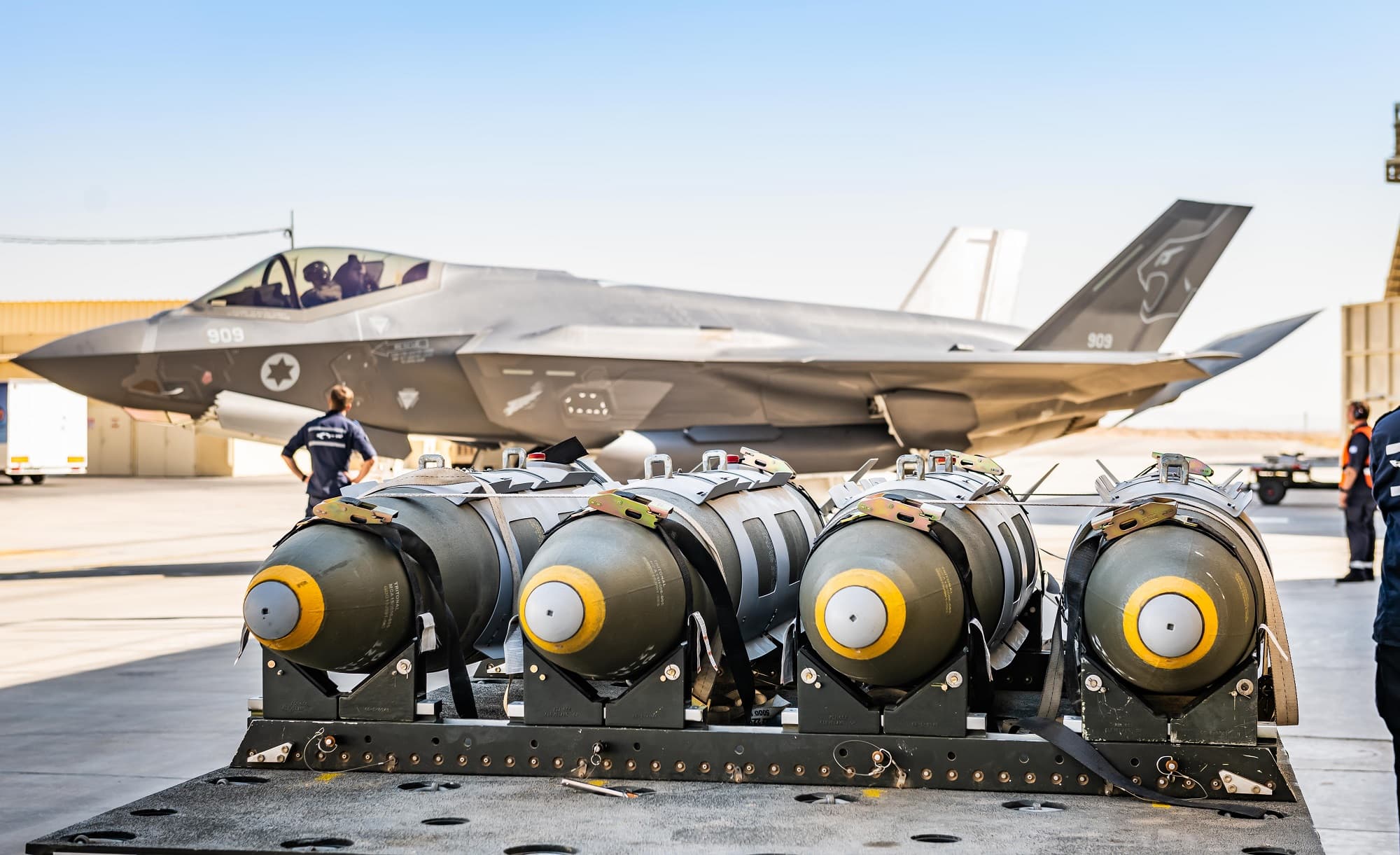
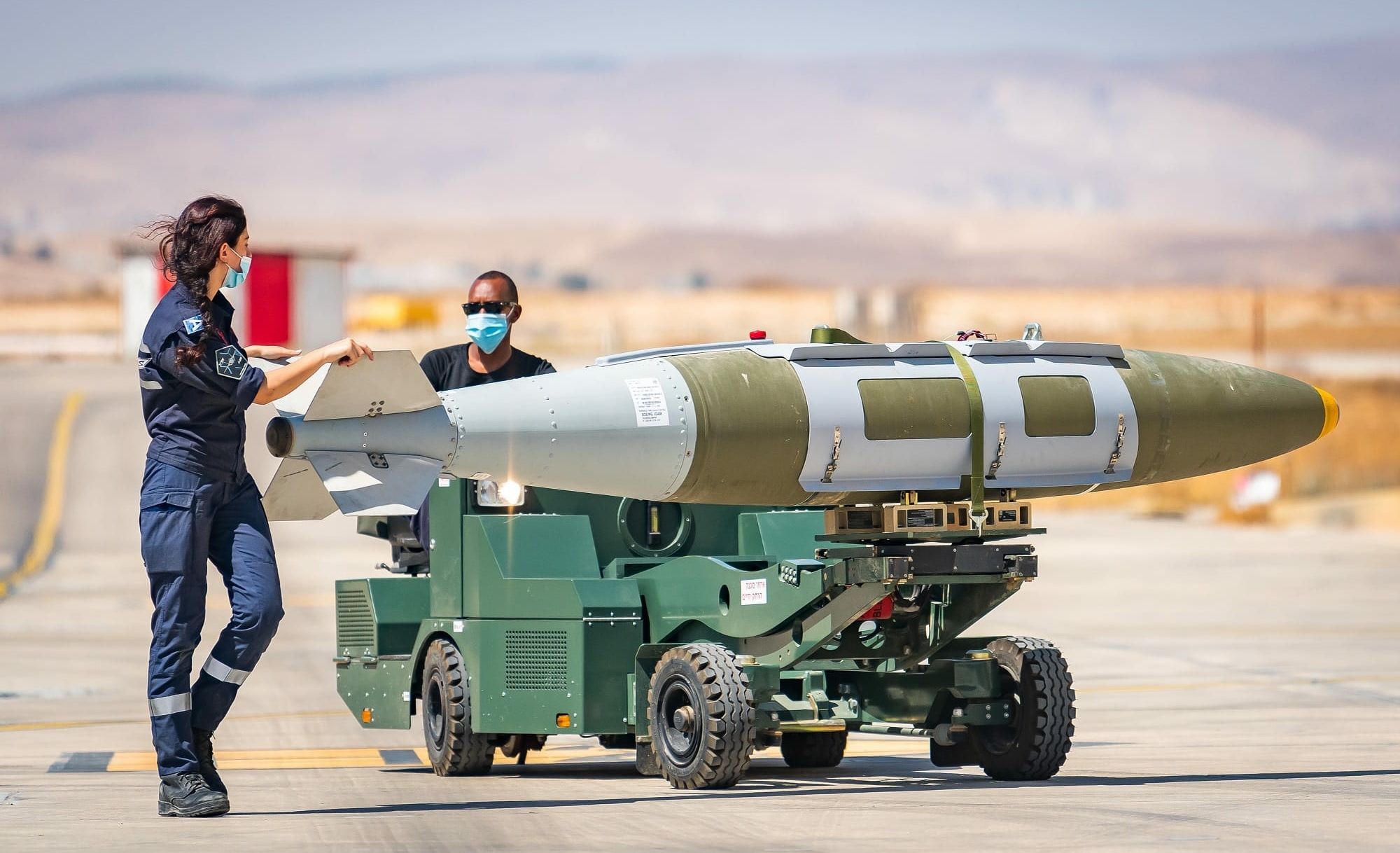
With the help of reverse image searches on the internet and various military manuals, we were able to determine that this is a standard aerial bomb that has been converted with an external guidance system into a “smart bomb” that is guided towards the target using GPS. With technical assistance from the international research centre Lighthouse Reports, we were then able to determine the GBU-31 by visual comparisons of the external system.
FACTS
The outer guidance system that converts the bomb into a ‘smart bomb‘, which is guided towards the target using GPS, is manufactured by American Boeing. Boeing only markets four models of the guidance system, and visual comparisons show that the bomb in the Israeli Air Force video is the leftmost type – a GBU-31.
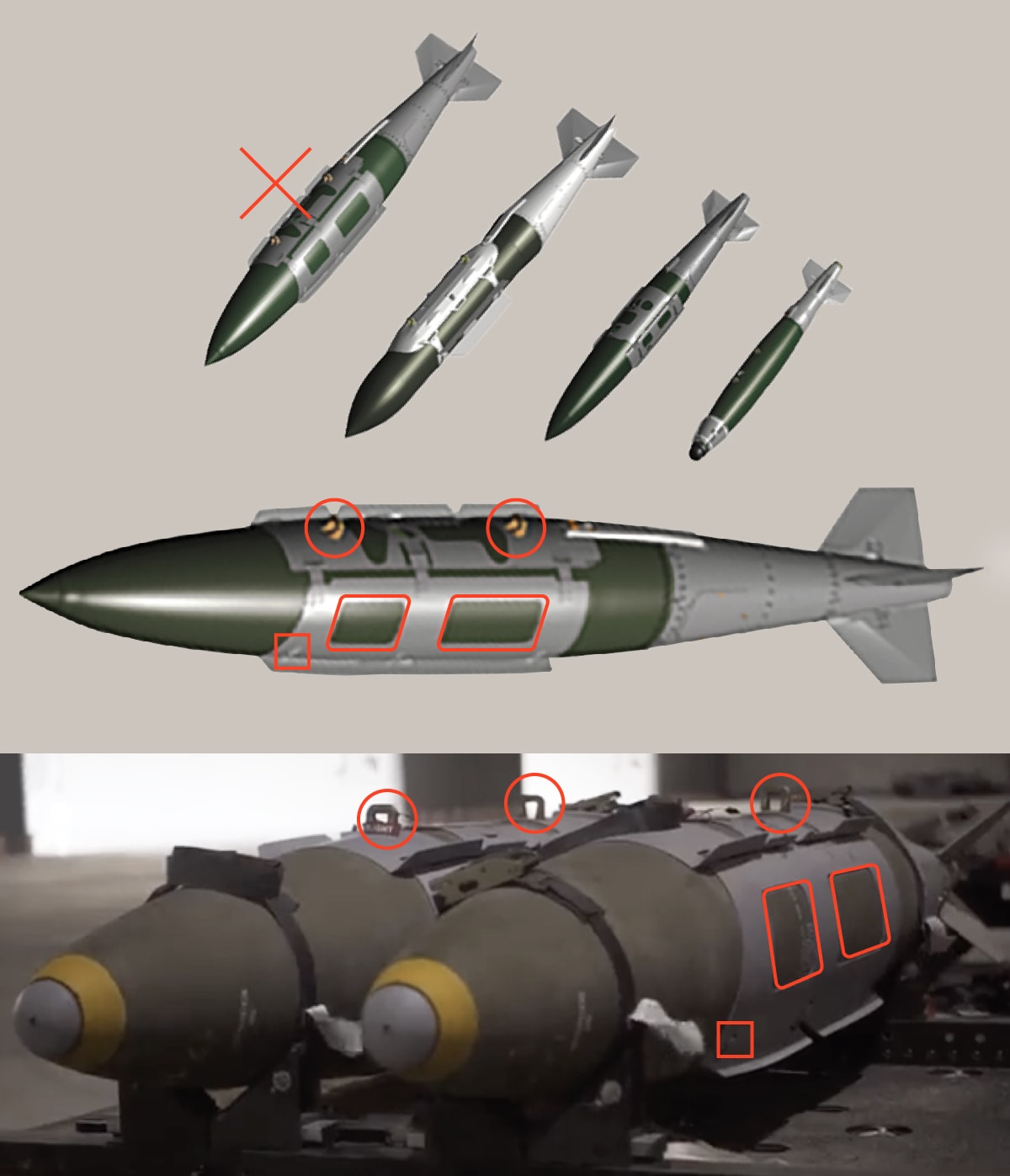
The Israeli Air Force video was posted on 8 August 2022, the day Israel’s Operation Breaking Dawn in Gaza ended, and in a commentary on the video, the Air Force states that the F-35s have just participated in the three-day bombing campaign. It has not been possible to determine which bombs were used over Gaza during the three-day offensive in August 2022, when at least 32 Palestinians, including eight children, were killed by Israeli air strikes.
However, we have evidence that Israel used the controversial bombs during the Gaza war in May 2021, where we know that the Danish-equipped F-35 fighter aircraft actively participated. Among other things, the bombs were used on 16 May in the deadliest attack of the war, when Israeli bombs caused three residential buildings to collapse, killing 44 civilians, including 18 children.
According to months of investigation by the New York Times and Human Rights Watch, the collapse of the residential buildings was most likely caused by four GBU-31 bombs dropped by Israeli aircraft on the road and pavement a few metres from the buildings.
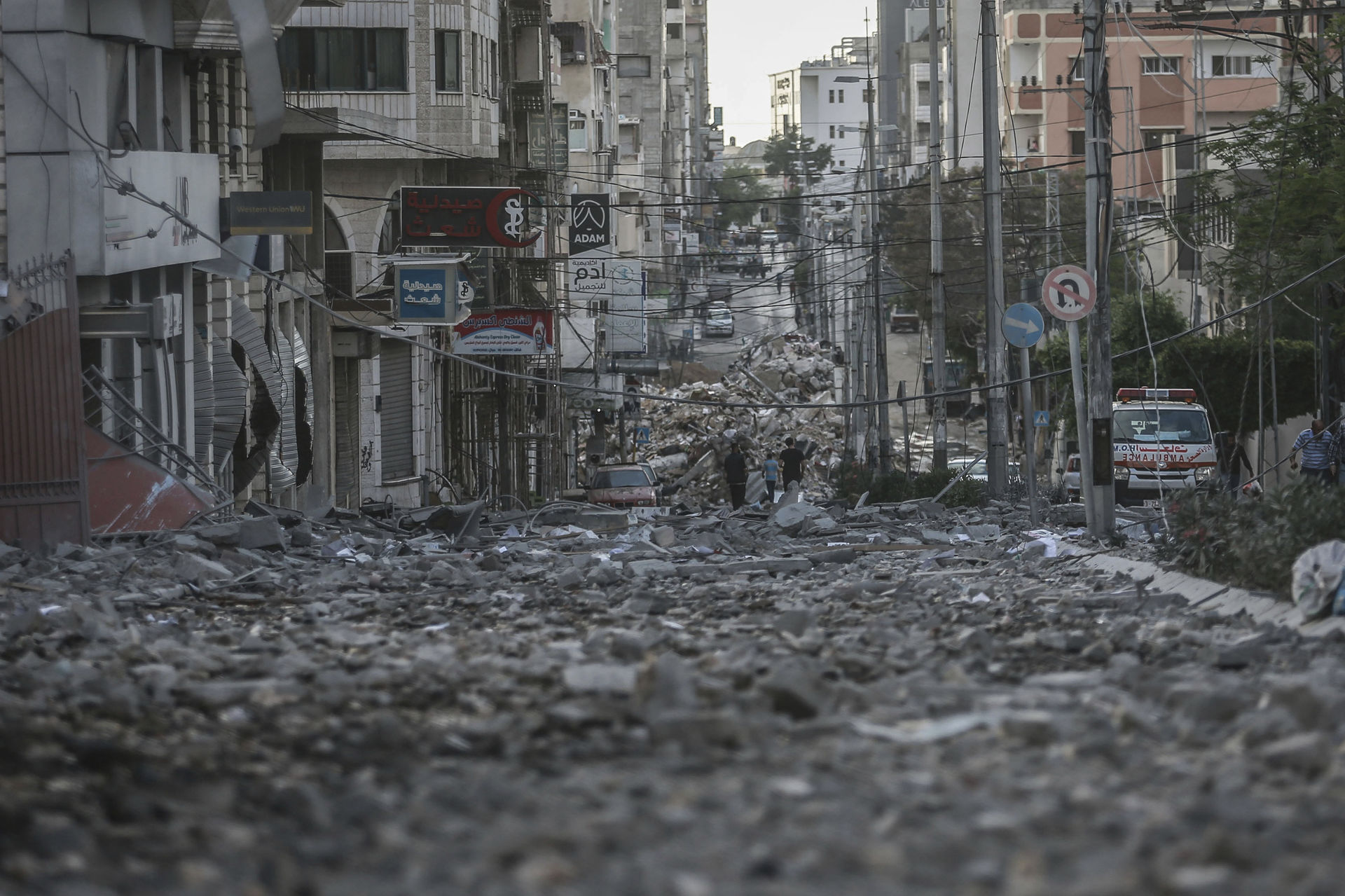
According to the New York Times, Israeli authorities report that Israeli military attempted to hit the Hamas movement’s underground tunnel system, but Hamas turned out to have a larger underground command centre on site, causing the buildings along the road to collapse. However, Israel has not provided any evidence for this claim and Hamas denies that this is the case.
Amnesty International believes that the Israeli military should have anticipated “the potentially catastrophic consequences” of dropping such heavy bombs in such a densely populated area. And Human Rights Watch wrote in a report on the attack that “the use of high explosive munitions such as GBU-31 bombs in such a densely populated area caused foreseeable harm to civilians and civilian objects”.
The laws of war dictate that civilians must be warned if military infrastructure in their vicinity is attacked, but none of the residents of the buildings were warned, according to the New York Times and human rights organisations.
After lengthy investigations. both Amnesty International and Human Rights Watch consider the bombing to be a possible war crime, and Amnesty believes it should be part of an upcoming investigation of Israel by the International Criminal Court, ICC.
GBU-31 bombs were also used during other major attacks in May 2021. According to an investigation by Al Jazeera TV, it was most likely this type of bomb that was used when a 13-story media centre in Gaza was levelled during the war on 15 May 2021.
The media centre was home to the Associated Press news agency, Al Jazeera TV station and a number of other media outlets in Gaza, but Israel claims that the building also housed militants from the Hamas movement.
The Israeli military warned the owner of the building an hour before the bombing and no civilians were killed in the attack. However, both the Associated Press and the Committee to Protect Journalists condemned the bombing as an attack on press freedom in Gaza, and Reporters without Borders has called on the International Criminal Court (ICC) to investigate the attack as a war crime.
It has not been possible to say which Israeli aircraft dropped the bombs on 15 or 16 May 2021. Although we know that the Danish-equipped F-35s actively participated in the operation, several other Israeli fighter aircraft can also carry these bombs.
Danwatch and Information have asked the Israeli Defence Force, IDF, if their F-35 fighter aircraft carry GBU-31 bombs and if they have used the bombs in attacks in Gaza. They have not answered this question.
Israel’s use of the controversial GBU-31 bombs in Gaza has been criticised for many years before Israel took delivery of the F35 aircraft.
After the three-week war in Gaza in 2014, which claimed the lives of at least 1,462 Palestinian and 5 Israeli civilians, Israel was criticised by a commission established by the UN Human Rights Council for using GBU-31 in Gaza.
The UN Commission assessed that “however accurate the bomb is, it remains highly questionable whether a weapon with such a wide impact area allows its operators to adequately distinguish between civilians and civilian targets and the military targets of the attack when used in densely populated areas.”
The Commission concluded that the use of the GBU-31 in densely populated, built-up areas of Gaza is likely to constitute a violation of the prohibition on indiscriminate attacks. ‘Indiscriminate attacks’ refers to attacks that do not distinguish between military and civilian targets, which is prohibited and can be a war crime under international law.
This assessment is shared by Katharine Fortin, Senior Lecturer in International Law and Human Rights at Utrecht University, who specialises in international law during armed conflict.
She emphasises that it is a cardinal principle of international humanitarian law that belligerent parties distinguish between legal, military targets and illegal, civilian targets. That’s why international law prohibits the use of arms that are inherently indiscriminate, for example because they are inaccurate or incapable of being directed.
“But the law also prohibits belligerents from using arms that, while not indiscriminate, have an indiscriminate effect because of the circumstances in which they are used,” she says.
“When explosives with a wide impact area are used in a densely populated area, there is a high chance that they will be rendered indiscriminate and therefore illegal.”
Although Israel’s GBU-31 is a “smart bomb” that is guided relatively accurately with GPS, it can still act randomly because it is so powerful.
Katharine Fortin adds that the use of explosive arms with such a large impact area in a densely populated area also risks violating two other important rules of international law; that you must always take care to spare the civilian population and civilian objects when planning attacks, and that an attack should not be carried out if the civilian casualties are expected to be too high in relation to the direct military advantage sought.
Defence giant Terma and a number of other Danish companies have received orders worth more than DKK 3.7 billion to supply military equipment to F-35 fighter manufacturer Lockheed Martin, which has so far delivered 36 F-35 aircraft to Israel out of a total of 50 ordered by the country. According to military experts, several of the Danish-produced parts are crucial for the aircraft to be fully operational, and Terma has, among other things, supplied the pylons – or weapon stations – that hold and launch the aircraft’s external bombs and missiles.
The pylons are removable, and in the Israeli Air Force video of the GBU-31 bombs, the pylons are not on the F-35 aircraft, whose internal bomb bay is open. However, according to an overview from the US Air Force F-35 programme, the state-of-the-art fighter aircraft can also carry GBU-31 bombs remotely under its wings.
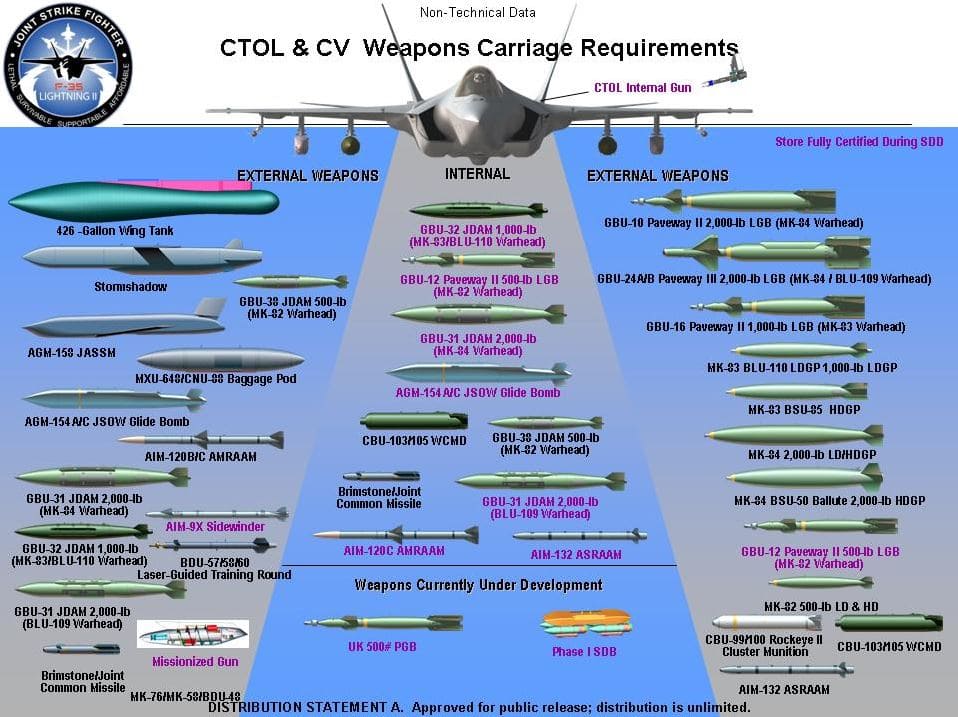
Neither Terma nor Lockheed Martin have responded to our inquiries as to whether it is the Danish-made pylons that hold – and drop – the mega-bombs. But two photos from the US military show GBU-31 bombs hanging under the wings of an F-35 aircraft in what look like Terma’s pylons:
Danwatch found two photos in Israeli media and on the Israeli Air Force’s Facebook page of Israeli F-35s with what appear to be Danish-made pylons loaded with bombs. In both cases, however, the bombs are not GBU-31s.
Violations of the laws of war in Gaza have been happening for so many years that Denmark should have foreseen that Danish equipment could be involved, says Omar Shakir, Israel and Palestine Director at Human Rights Watch. He says that the discovery of GBU-31 bombs is yet another argument in favour of Denmark completely suspending deliveries to Israeli F-35s.
“In Gaza, there are more than 2.1 million people in a 40 by 11 kilometre strip of land. And the Israeli practice has been to frequently drop high-explosive arms in densely populated areas here in ways that have been documented as disproportionate and have led to civilian casualties,” he says.
“This history of violations of international law should be understood by those who want to do business with the Israeli military. It is a long-standing practice of the Israeli government and one that clearly has huge civilian consequences.”
Danwatch has previously shared an Israeli news report in which an anonymous F-35 pilot describes what it is like to bomb in Gaza, one of the world’s most densely populated areas with 2.1 million people in an area the size of Langeland:
“In Gaza, you’re never happy about having to attack. You say to yourself: ‘I to do my job precisely and I must not make any mistakes’. It’s the last place in the world where you should make mistakes,” he says.
You can read more about the Danish-equipped F-35 missions in Gaza here:
This is the story of a Danish export venture. It is also the story of a 5-year-old girl killed in the streets of Gaza. And the story of 36 F-35 fighter aircraft loaded with Danish hardware.
The first of the fighter aircraft arrived in Israel on a December morning in 2016 and was quickly nicknamed Adir, ‘Mighty One’. A few years later, Israel became the first country outside of the US to put the super-advanced fighter aircraft into service.
Attached underneath the wings of the new aircraft is the result of a Danish industrial offensive: six high-tech pylons, developed and produced in Eastern Jutland, that hold and drop the aircraft’s external bombs. And this is just one of 80 Danish parts developed for the F-35 fighter aircraft.
But there is a price to pay for being an arms-producing nation.
Today, Danwatch, in collaboration with the newspaper Dagbladet Information and Lighthouse Reports, reveals that in 2021 and 2022, Danish-equipped F-35 fighter aircraft participated in bombing campaigns over Gaza that have cost the lives of more than a hundred civilians. 75 of them were children.
The Israeli military will not disclose which bombs were dropped by the F-35 fighter aircraft, but we managed to identify two days when the fighter aircraft were in the air during operations over Gaza.
To find out what happened during those two days, we scrutinised the Israeli military social media, operations reports, local news reports, Danish and American arms manufacturers’ PR material, as well as photo and video footage from bombing raids and satellite maps.
This is the story of those two days, of bombing raids, of civilian casualties and of Danish-equipped fighter aircraft.
11 May 2021
It is early in the morning on 11 May 2021, in an apartment on the sixth floor in northern Gaza. It’s Ramadan and the Subuh family has gathered for suhoor, the meal before sunrise and the daily fast. Amira Subuh tells her son Baraa to go back to bed and goes to her own room, where she sleeps with her other son ‘Abd a-Rahman, who suffers from cerebral palsy.
This is the last time they speak.
Meanwhile, around 80 Israeli fighter aircraft and drones are preparing to take off towards northern Gaza. An operations report reveals that eight of the Danish-equipped F-35s are among those participating in the operation that day. Their goal is to cause extensive harm to the militant Hamas resistance movement.
Over the next few hours, fighter aircraft and drones attack 130 targets. One of the targets is a Hamas battalion commander who, according to Israeli intelligence, is staying in an apartment in northern Gaza, close to the Mediterranean Sea.
Somewhere in the airspace, a crosshair is aimed at the building where the Hamas commander is believed to be. A bomb is dropped. Black smoke billows. Mission completed.
Later that morning, the Israeli air force posts a video on Twitter showing footage of the attack. They are confident that they have hit their target.
But on the ground, the reality is different.
Using satellite imagery, Danwatch located the building that was bombed in the video.
The residential block is located in Al Shati’, a refugee camp in northern Gaza. This is where Amira Subuh and her disabled son are lying in their beds in their sixth-floor apartment.
Outside on the street, Amira Subuh’s third son, Mu’az Subuh, is heading towards his mother’s home after morning prayers. He is about 50 metres from the white building when all hell breaks loose.
Mu’az hears a loud explosion and smoke and dust spread everywhere. People start shouting. He tries to enter the building, but people in the street hold him back. He looks up and sees that the sixth and seventh floors have collapsed.
“I lost all hope that my family was alive,” he tells the human rights organisation B’tselem.
The apartment that was bombed on 11 May 2021. Photo from @qudsn on Twitter.
Upstairs in the apartment, Amira Subuh’s other son and Mu’az’s younger brother, Baraa Subuh, was falling asleep when “the house suddenly collapsed” on him. Everything turns black, but he manages to dig himself free and starts searching for his mother and his disabled brother who had been sleeping in the room next to him.
It takes a long time to dig them out of the rubble. But by then it is too late. “They are gone and so is our home where we had a good life together,” Baraa tells B’tselem.
Amira Subuh and her disabled son Abdul-Rahman Subuh, 19, were killed in the attack. Private photo via B’tselem.
Meanwhile, the real target of the attack, the Hamas battalion commander, was unharmed.
Although he lived on the seventh floor in the apartment above the Subuh family, he was not at home that morning and was therefore not injured during the bombing. This was confirmed by the Palestinian human rights organisation Mezan and the Israeli human rights organisation B’tselem.
We do not know which aircraft dropped the bomb on Amira and her son, but we have evidence that the Danish-equipped fighter aircraft were participating in the air strikes on northern Gaza on the same day that the two civilians were killed. And they were just some of the first civilian victims of the May 2021 bombing campaign that Israel named Operation Guardian of the Walls.
Over the next 11 days, the Israeli Air Force bombs more than 1,500 targets in one of the world’s most densely populated areas. And Danish-equipped fighter aircraft participated in the operation.
130 Palestinian civilians lost their lives, 67 of them were children.
Human Rights Watch believes that Israel has committed a number of potential war crimes during this operation as not enough is was done to avoid civilian casualties. According to the human rights organisation, at least 62 Palestinian civilians were killed by Israeli attacks, without a military target in close proximity.
In a written response to Danwatch and Information, the Israeli Defence Force (IDF) confirm that the Danish-equipped F-35s, or Adir as they are called, were part of the 11-day bombing campaign.
“The Adir aircraft were part of the Israeli Air Force’s fighter aircraft capability and participated in ‘Operation Guardian of the Walls'”, an IDF spokesperson wrote.
The Israeli military have informed Danwatch and Information that the attack in which Amira Subuh and her son were killed is under investigation, but they do not wish to comment further on the incident.
The Israeli military states that they only bomb military targets and that they otherwise “take every possible precaution to minimise civilian casualties during operations in the densely populated area”.
Yet civilians, including eight children, die in an Israeli bombing campaign just one year later. But before we come to that, we must go back 20 years in time to an airport northeast of Paris.
On 17 June 2003, the large arms fair, Paris Airshow, had already been taking place for two days at Le Bourget Airport when a decisive moment for the Danish arms trade occurred. At the pavilion of fighter aircraft manufacturer Lockheed Martin at stand A-399, preparations were made for a ceremony. At around 2 pm, a man named Tom Burbage signs his name on an important document.
At the time, Tom Burbage was the Executive Vice President of Lockheed Martin, and the document included an agreement with the Danish defence company Terma to supply parts for the F-35 fighter aircraft that were being development to become state-of-the-art.
In 2023, 20 years later, producing fighter aircraft is a billion-dollar business for the Danish defence industry. Here you can see some of the main parts that Danish companies have supplied for the aircraft.

Terma is Denmark’s largest defence company and the main supplier to the F-35s. Last year, deliveries for the fighter aircraft generated a turnover for Terma of just over 1 billion DKK. Terma currently employs more than 800 people to produce parts for F-35s alone. More than 700 F-35s with Terma parts have already been delivered and more than 3,000 are in the pipeline, according to the company.
Terma says it supplies around 80 parts for the fighter aircraft, but it is the equipment on the underside of the aircraft that is particularly noteworthy. On each wing are two pylons – a kind of weapon station – used to transport and launch bombs and missiles during military operations.
Photo: Israeli Air Force IAF on Facebook. Graphic by Danwatch.


Lockheed Martin have confirmed to Danwatch, Information and Lighthouse Reports that all F-35s have a number of components from Terma – including the weapon stations.
Military experts consider all of the parts supplied by Terma as essential for the aircraft’s use in military operations.
This Danish export venture has only been possible because successive Danish governments have given it top priority for the country’s defence and security policy.
According to the same Danish authorities, observing human rights and international law is vital when exporting Danish arms and military equipment. For this reason the Ministry of Foreign Affairs has traditionally been against allowing military export from Denmark to Israel. The risk of the equipment being used for serious human rights violations is far too high.
However, Terma’s exports are made possible by Denmark’s participation in the US-led defence cooperation on the F-35 aircraft, where the Danish parts are first sent to Lockheed Martin in the US.
And Foreign Minister Lars Løkke Rasmussen (M) is now proposing to take further advantage of this circumvention.
Arab Emirates, whose militaries have been responsible for human rights violations and the killing of civilians.
“It is possible to be a country that is problematic from our standpoint and still have some legitimate security policy interests,” he told the Danish newspaper Politiken.
At the same time, he mentioned that the government will relax its stance on the resale of arms to and from the US when they are part of international cooperation projects.
Denmark will not “stand guard” over what the products are ultimately used for, was the message from the foreign minister.
The potential consequences of this approach can be seen on a summers day in 2022 in Gaza.
5 August 2022
On the afternoon of 5 August 2022, 5-year-old Alaa Qaddoum takes to the street to escape the stifling heat caused by the power outage inside. Out on the street in the neighbourhood of Shujaiya in Gaza City, she is greeted by sunshine from a cloudless sky, the temperature has crept well above 30 degrees.
50 kilometres further inland at Nevatim Air Base, pilots from Israel’s Golden Eagles squadron are preparing the Danish-equipped F-35 fighter aircraft for take-off. The pilots were off duty, but earlier in the day they were suddenly told to report to the base.
A little after 4 pm, Alaa plays with her 7-year-old older brother outside the local mosque, where people are gathering for the afternoon prayers.
Meanwhile, the F-35 fighter aircraft have taken to the skies. Together with other aircraft and drones, they launch a surprise bombardment of the Palestinian enclave.
“At 4.15 pm we were in the middle of the operation,” an Israeli F-35 pilot recounts a few days later in a TV report about the operation on an Israeli news broadcast:
The whole thing takes only 170 seconds. The pilots home in on the target, drop the bombs, and the explosions turn the sky grey. The bombs fall over Gaza in a coordinated attack. Four to five tremendous blasts are heard as the seventh floor of a high-rise building in Gaza City is bombed.
From the F-35 fighter jets, the pilots can look down on Gaza, one of the most densely populated areas in the world with 2 million inhabitants, an area the size of Langeland.
“In Gaza, you are never happy to have to attack”, says one of the F-35 pilots subsequently on Israeli television, who has chosen to conceal his identity.
“You tell yourself: I have to be precise in my work and not make any mistakes. This is the last place in the world where you can make a mistake”.
While these thoughts cross the minds of the pilots above Gaza, Alaa Qaddoum, unaware, is playing at the mosque. At approximately 4.15 pm, an Israeli missile hits a member of the Palestinian militant group Islamic Jihad who is at the mosque.
Alaa Qaddoum’s father, Abdullah Qaddoum, who according to the Israeli military is a member of Islamic Jihad, is also part of the target, the Israeli military explain to Danwatch. But it is his 5-year-old daughter who is killed.
Shrapnel hits Alaa Qaddoum in the chest, leg and forehead. She dies instantly. The Israeli military tells Danwatch they regret that it is Alaa Qaddoum and not her father that they ended up killing.
“Unfortunately, the reports after the attack indicated that one unfortunate victim was his daughter, who was in his vicinity during the attack. The incident is being investigated by the General Staff Fact-Finding and Assessment Mechanism”, the IDF writes.
Whether it was an F-35, another fighter aircraft or a drone that killed Alaa Qaddoum remains unknown, but she was to be the first of several children.
These surprise attacks were the start of Israel’s ‘Operation Breaking Dawn’, a three-day operation in which at least 32 Palestinians are killed by Israeli air strikes. Eight of the victims are children.


Two days after the surprise attack, a funeral procession moves slowly through the streets of Gaza. Alaa’s grandfather leads the way with Alaa’s dead body in his arms, wrapped in the Palestinian flag. Behind him, in a slow procession hundreds of men follow with blank stares.
We cannot say for sure which bombs were dropped by Danish-equipped bombers.
But we have evidence that, despite Denmark’s restrictive policy, fighter aircraft equipped with advanced Danish military technology have participated in bombing raids on Gaza on days and at times when civilians, including children, have been killed.
The Israeli Defence Force (IDF) confirmed to Danwatch and Information that the F-35 aircraft participated in Operation Breaking Dawn in August 2022.
“The protection of human life is a core value, including during armed conflict”, writes the IDF spokesperson.
The photographs show Alaa Qaddoum, the t-shirt she died in and her empty room. Photo: Samar Abu Elouf/Middle East Eye
Foreign Minister Lars Løkke Rasmussen has declined to be interviewed about the participation of Danish-equipped fighter aircraft in bombing operations in Gaza.
In a written response, the Ministry of Foreign Affairs stated that “the risk of equipment being used for human rights violations” is normally “a key parameter” in the assessment of applications for authorisation to export arms and military equipment. However, following a change in practice in 2000, the ministry does not carry out such assessments when it comes to “exports of sub-components for projects carried out in cooperation with EU and NATO countries”, the ministry explains.
“This also includes exports to the F-35 cooperation, which is led by the United States,” the Ministry of Foreign Affairs writes.
Defence company Terma did not want to speak with us either.
In a brief email to Danwatch and Information, Terma wrote that their exports are open and transparent and in full compliance with Danish legislation.
“At Terma, we are happy and proud to be part of the F-35 programme – and thereby make a significant contribution to Denmark’s important alliance with the US and other countries”, writes Terma’s Press Officer Sara Westphal Emborg Neergaard.
In light of the revelation that Danish aircraft parts could potentially be used for war crimes in Gaza, human rights organisations Amnesty International and Human Rights Watch are now calling on Denmark to stop deliveries for the Israeli fighter aircraft.
At the same time, a number of experts in international law and human rights warn that Denmark risks contributing to war crimes and believe that the exports are in violation of the UN Arms Trade Treaty, EU rules on arms exports and general international law.
Read about it here:
No posts
FACTS
From the Iqon skyscraper in Quito, Ecuador, to a triangular apartment building in New York and the CopenHill in Copenhagen.
The architecture of Danish star architect Bjarke Ingels boasts Danish innovation and talent, the world over.
Danwatch and Frihedsbrevet have evidence that the portfolio of Ingels and his architecture firm Bjarke Ingels Group’s (BIG) now also includes the controversial future city of Neom in Saudi Arabia.
The city of the future, often described as a dystopia, has been associated with murder and forced displacement even before the city opens it’s doors.
Neom is also a prestige project for Saudi Arabia’s de facto leader, Crown Prince Mohammed bin Salman, who is known for his brutal crackdown on dissidents.
BIG’s involvement in Neom has not been made public so far, but social media and reports from the Ministry of Foreign Affairs show that BIG has been paid by the Saudi regime for the concept design of the floating industrial city of Oxagon, which will be a part of Neom.
A report from the Ministry of Foreign Affairs states that BIG has “been responsible for the development of the master plans for the mega-projects NEOM and Qiddyah, which have a strong focus on sustainable development”.
BIG neither confirms nor denys whether it is involved in the city of the future, but a quote from Bjarke Ingels in the British newspaper The Guardian, may have hinted at it.
The Danish architect allegedly said that he is involved in a confidential project in Saudi Arabia, which he describes as a “human-made ecosystem that is as close to a utopia as you dare imagine”.
A phrase and sentiment that is often used when describing Neom.

Neom is the brainchild of Saudi Crown Prince Mohammed bin Salman and part of the large-scale ‘Vision 2030’ plan to move away from oil.
It is often referred to as one city, but in reality it is an area the size of Belgium that will be home to several cities of the future, raised from the endless sand in the middle of the desert.
One of the cities is the octagonal industrial mecca of Oxagon.
As with everything else in Neom, the plans are ambitious: the city will be split down the middle by a canal for heavy shipping traffic, and if the city comes into realization, it will be the world’s largest floating construction.
According to the published plans, Oxagon will be located on the Red Sea, close to the Suez Canal, one of the world’s busiest shipping hubs.
An ideal location that will eventually, if all goes according to bin Salman’s plan, become a key player in global trade.
“Oxagon will be the catalyst for economic growth and diversity in Neom and the Kingdom, further meeting our ambitions under Vision 2030” the Crown Prince has said.
And the man and the architectural firm behind it are Danish.
In addition to the MFA report, a number of BIG employees state on their LinkedIn profiles that they are working on the “North & South master plan
for Oxagon”, while partners
state that BIG is the architect behind the project.
Danwatch and Frihedsbrevet have not been able to determine when and to what extent BIG has been involved in the Neom project.
Overall, it has been difficult to get the multi-million dollar company to talk.
But for several years, the project has been plagued by incidents and criticism.
Notably, the assassination of dissident journalist Jamal Khashoggi in 2018 tarnished bin Salman’s vision.
The Crown Prince denies having been part of Khasghoggi’s assassination, but in 2021 the US published the American intelligence report,
which concluded that he authorized the assassination – and it was likely that he also ordered it.
Subsequently, the murder of Jamal Khashoggi prompted several architects to resign from Neom’s advisory board.
One of them was the world-famous architect Norman Foster, who wrote in an email to Danwatch that they are no longer part of the board.
In recent years, it has emerged that the dream of Neom has turned into a nightmare for the area’s indigenous population.
To accommodate the project – including Oxagon – at least 20,000 members of the Huwaitat tribe are to be forcibly evicted from their land, a move that has been heavily criticized by several organizations.
“The effort to forcibly displace the indigenous population violates every norm and rule of international human rights law,” said Sarah Lea Whitson who is Executive Director of Democracy for the Arab World Now among other titles.
For those who have rebelled, it has been at the risk of their lives.
One of whom was Abdul Rahim al-Huwaiti, who was shot dead by Saudi security forces while fighting for his home.
Footage of Abdul Rahim al-Huwaiti’s murder was shared in several videos over Twitter. In one of them you can hear Saudi security forces firing successions of gunfire, while in another you can see his home destroyed by bullet holes. Video: Abdul Rahim al-Huwaiti (subtitles by Danwatch)
Others who have resisted have been imprisoned or sentenced to death.
A recent report on Neom’s human rights violations conducted by the Saudi human rights organization ALQST, listed 15 people who had received prison sentences, ranging from 15 to 50 years, and five others who had been sentenced to death.
The stories from Neom are irreconcilable to what BIG has pledged in their 2021 Sustainability Report.
It states that “human rights are undeniable universal truths”.
“We are unwavering in our determination to give all people, as far as we can, the rights and freedoms they wish to enjoy. BIG will never knowingly be complicit in human rights abuses, but will instead always seek to uphold the rights and freedoms of all, and to contribute where we can”, the report reads.
Danwatch and Frihedsbrevet wish to discuss with Bjarke Ingels and BIG how their involvement in Neom complies with their sustainability report.
We want justification for their involvement in a project that is accused of gross human rights violations, so much so, that it has led other architects to withdraw their services.
Over several months Danwatch and Frihedsbrevet attempted to get answers from Bjarke Ingels and BIG; however, they failed to get them to comment on Neom.
Despite being a large international company, BIG’s press department can only be contacted by email.
Danwatch contacted them for the first time in January. After months, we received a reply from BIG partner Daria Pahhota. She apologized for the late reply, explaining that she and Bjarke are “currently on a documentary shoot”, but that she will look into the possibility of an interview “when we have some down time”.
After that, there was complete silence for over a week.
It was only after Frihedsbrevet and Danwatch sent specific questions about BIG’s involvement in Neom that we received a reply.
“Unfortunately, neither Bjarke nor Sheela (Director of BIG) are available for an interview right now, and we cannot confirm or deny our involvement in the Neom project”.

For the past few years, Bjarke Ingels has been touring with his vision “Masterplanet”. An idea to redesign our planet to make it more sustainable and climate-friendly. In short, a plan to save the world.
Meanwhile, BIG has been in oil-dependent Saudi Arabia, which, according to numerous reports, is subjecting its own population to gross human rights violations.
For example, in 2019, it was announced that BIG had designed the master plan for the Saudi entertainment city of Qiddiyah, which is currently under construction.
In particular, Saudi Arabia has been criticized for restricting freedom of expression, and the freedom of assembly and association, while the occurrence of the death penalty has almost doubled in the last six years.
“It is no secret that there are many challenges in Saudi Arabia when it comes to human rights. That is labour rights, the rights of women, sexual minorities, defenders of human rights and journalists,” Louise Holck, Director of the Danish Institute for Human Rights, has previously told Danwatch.
We asked BIG what considerations they made about being involved in Saudi Arabia, a country notorious for human rights abuses.
In the short response we received from BIG, partner Daria Pahhota wrote, “it is oversimplifying a large and complex urban planning project that is creating new buildings and public spaces for the ever-growing Saudi population,” when critics conflate working on Neom with working in Saudi Arabia.
She goes on to say:
“BIG, like other international firms, is active in the Middle East because architects contribute to positive development by providing new schools, libraries, cultural buildings and urban spaces.”
Bjarke Ingels has made similar statements in the past. Ingels told The Guardian,
“I do sincerely believe that the urban transformation of Saudi Arabia that we’re taking part in is part of paving a path to a clearly needed social and cultural reform of the country”.
And when Ingels met with controversial Brazilian President Jair Bolsonaro in 2020 to discuss options for an economically and ecologically sustainable tourism plan, the rhetoric was similar.
“Making a list of countries or companies that BIG should avoid working with seems to be an oversimplification of a complex world. Dividing everything into two categories is neither accurate nor fair,” Ingels continued:
“We cannot expect every public body to align with every aspect of our thinking. If we want to positively change the world, we need active engagement – not superficial clickbait and ignorance.”

But this view is criticized by the Saudi human rights organization ALQST.
“When a company or an architect is part of Neom, they are also giving legitimacy to a project that is killing people. Neom is built on blood”, said Lina Alhathloul, Head of Communications at ALQST, via a voice message on Signal.
“So those companies and architects have a responsibility when they do business on bloodied soil without establishing the conditions to uphold human rights”.
In a comment in the architecture magazine Deezen, author and urbanist Adam Greenfield shares the same opinion:
“There is no other way about it: If you accept money to work on any aspect of the Neom project, know that you are complicit in these acts of violence,” writes Adam Greenfield.
We have presented this criticism to BIG, but it has also gone without receiving a response.

Drink alcohol or go to jail.
10,000 kilometers away from Denmark, in China’s northwestern Xinjiang province, this is a choice that many Uyghurs have been facing since the 2010s.
This pressure comes from the Chinese government, who over the past decade has thrown Muslim people into internment camps, subjected them to forced sterilization and mass surveillance due to their culture and faith.
Leaks and testimonies show that alcohol has played an important role: If you drink alcohol, you go free; if you choose Islam and say no thanks, you may pay the price.
For roughly the same amount of time, from 2015 onwards, Danish brewing giant Carlsberg has been operating in the same province producing the local beer, Wusu Beer.
An operation that experts believe the Chinese government has used to suppress the approximately 12 million population of Uyghurs living in Xinjiang.
This is based on extensive research of the open Chinese media, leaked documents and testimonies from Uyghur refugees, conducted by Danwatch in cooperation with TV2.
In particular, experts are criticizing Carlsberg’s sponsorship of a beer festival in a province where alcohol is used as a means to establish whether someone is a radical fundamentalist or not.
“Carlsberg is aiding the Chinese government with their repression in Xinjiang,” says Rune Steenberg, one of Europe’s leading Uyghur researchers, who has lived, researched and conducted anthropological fieldwork in Xinjiang.
Carlsberg declined to be interviewed. In an email response, Carlsberg’s communications director wrote that Wusu’s role is “limited to sponsorship, including tastings, advertising and the sale of beer during the festival”.
Carlsberg’s communications director also stated that there is no evidence that their sponsorship of the beer festival is “suppressing the indigenous Uyghur culture”.
For the past eight years, Carlsberg has owned five breweries in the Xinjiang province, which is considered one of the most controversial and cut-off places in the world.
One of the breweries is located in Wusu town, which hosts the annual Wusu Beer Festival.
In the programs and photographs online that Danwatch and TV2 sourced, the festival resembles one in Denmark: Concerts with popular musicians and parades through the city.
All baring the Wusu Beer logo.
But as with everything else in Xinjiang, this kind of festival must be seen in the context in which it is held, explains anthropologist Adrian Zenz, who helped leak the “Xinjiang Police Files,” which revealed the Chinese state’s repression of the province’s Uyghur people.
“An activity like a beer festival is designed to pull people away from their religion, rules and way of life”, says Adrian Zenz.
What is also problematic is that the festival mixes traditional Uyghur dance and costume, originating from a Muslim tradition in which alcohol is forbidden, with beer, explains Rune Steenberg.
“It is provocative and disrespectful”, says Rune Steenberg.
“It is the equivalent of a Danish butcher filming a bacon commercial with Orthodox Jews dancing and chewing pork in Israel”.
To understand this, you need to understand what is happening in Xinjiang.
In recent years, reports of the repression of ethnic minorities in Xinjiang have become widespread.
Especially from 2017 onwards, reports and leaks have confirmed the systematic persecution of the Uyghur people in particular, who make up around 45 percent of the population in the province.
Most central to Beijing’s approach has been the creation of hundreds of detention camps, where it is likely that up to a million people have been incarcerated.
According to several accounts, they have been subjected to torture, rape, forced sterilization and indoctrination to the ‘correct Chinese mindset’.
Internment has meant that families have been split up, and Uyghur children have been sent to Chinese orphanages where they are taught to love their Chinese homeland and its government.
Thousands of mosques and religious symbols have been demolished, and the Chinese government is closely monitoring the inhabitants of Xinjiang.
What they do, where they are and who they associate with.
Director of the organization Nomogaia, Kendyl Salcito, who co-authored two reports on Western business relations in Xinjiang, calls China’s treatment of Uyghurs “a silent annihilation”.
“I think it’s important for people to understand that the type of repression that is going on in Xinjiang is not of the type that we saw during the Srebrenica massacre or the genocide in Rwanda. This is not a sudden outbreak of violence. This is a slow, systematic, deliberate cleansing of culture and people”, says Kendyl Salcito.
The US, several governments and NGOs share this view and have called China’s treatment of the Uyghur people a genocide.
In September 2022, the UN involved itself and after much rigmarole, they concluded that China has committed human rights violations so serious that they amount to crimes against humanity.
China has maintained that all accusations are “the lie of the century”.
Instead, the Communist Party says, it is fighting religious extremism and poverty in the predominantly Muslim province.
In practice, this has led to effectively outlawing the Muslim culture and lifestyle in a province where more than half of its population is devoted to Islam, explains Adrian Zenz.
“If Islam says that you can’t drink alcohol or eat pork, then the state will make people do exactly that under the guise of fighting religious extremism”, says Adrian Zenz.
According to Adrian Zenz, the consequence is that Uyghurs now live with the risk of being sent to an internment camp if they refuse to participate in events that the state expects them to.
“They know they can be labeled as religious extremists. That’s how the system works. It’s a police state”, says Adrian Zenz.
Leaked documents, the testimonies of escaped Uyghurs and the Chinese media confirm the same story: Uyghurs have been widely detained or thrown into prison for growing a slightly too long beard, for praying, for fasting, and even: for not wanting to drink alcohol.
Alcohol has played a major role in China’s criminalization of Islam in Xinjiang, says anthropologist Rune Steenberg.
“Alcohol has undoubtedly been an active tool in the oppression of the Uyghurs. Especially in creating an environment where people have not been able to remain Uyghur in any strong expression without being labeled as an Islamist or radical fundamentalist”, says Rune Steenberg
An excerpt from a leaked dataset of people detained from the early 2010s up to 2018 in the Konasheher area of Xinjiang, which Danwatch and TV2 were given exclusive access to by Adrian Zenz, illustrates the role of alcohol in the province.
The dataset, which covers only a fraction of all detainees in Xinjiang, shows that 175 people were in detention camps on the grounds that, among other things, they did not drink alcohol.
One of them was Memeteli Turghur, who was detained because he did not smoke or drink, according to the dataset.
Below are 10 people who have been imprisoned for refusing to drink alcohol.
Up to one million people are believed to have been incarcerated in the Xinjiang internment camps. Some of them for not drinking alcohol. Read about some of them here:


Uyghur children’s author Abduweli Ayup has also seen alcohol used against Uyghurs in Xinjiang.
Danwatch and TV2 visited him in the Norwegian city of Bergen to discuss what he witnessed on a summer day back in 2015 in a suburb of Kashgar, located in Xinjiang.
In the middle of Ramadan, when Muslims fast during the day – 20 people had lined up in a horseshoe to take part in a drinking competition.
“What’s going on here, I thought. Normally you wouldn’t see people eating on the street during Ramadan and it is inconceivable that people would drink alcohol in public”, says Abduweli Ayup about the incident.
It was not long before he realized what was actually happening. The competition, he says, was organized by official ombudsmen and the military, and the participants were mainly from the minority: Uyghurs like himself.
At the end of the horseshoe was a Chinese woman with a megaphone, uttering words of encouragement to the drinking crowd.
“You are brave, you are defying religious extremism”, echoes Abduweli Ayup.
Behind the woman were paramilitaries and police officers with weapons, and Abduweli Ayup could sense that the men drinking felt threatened and coerced.
“They looked really scared. Many tried to hide their faces, and some of them could hardly hold their glass properly because their hands were shaking so much. It looked like they were torturing themselves,” Abuweli Ayup told Danwatch and TV2.
“It wasn’t like they were drinking beer, but poison”.
A similar session was reported in Xinjiang during the same summer, and several videos online show allegedly similar instances in the province.
According to Abduweli Ayup, the videos are similar to what he witnessed.
He also said that the beer they were drinking was Wusu Beer.
The dataset of the detained Uyghurs, which Danwatch and TV2 have access to, shows that people have been imprisoned because they would not sell alcohol or cigarettes in their shops.
In 2015, Berlingske newspaper reported a similar practice.
In the small town of Aktesh, the Communist Party had launched a campaign to “weaken Islam”, an unnamed local party secretary told Berlingske.
According to the newspaper, this campaign dictated that shopkeepers in the village were now required to stock at least five different brands of alcohol and cigarettes or risk “the closure of their shop, having their business suspended and facing legal action”.
In 2015, the same year that the Chinese government ran its ‘sell alcohol’ campaign in Aktesh, Carlsberg bought full ownership of the Wusu Beer brand in Xinjiang. In a report on Chinese state television, a journalist states that Wusu has 85 percent of the market in the province.
Carlsberg has been critizised for being present and doing business at a time when the stranglehold on Muslim minorities intensified.
According to Adrian Zenz and Rune Steenberg, Carlsberg and Wusu Beer must have been aware of the state pressure to drink alcohol.
“They know that there are many Uyghur shops and restaurants that did not sell alcohol until seven years ago. Wusu is one of the beers that has been forced into Uyghur businesses. And because so many businesses have been forced to sell alcohol, we can assume that Carlsberg has profited from this,” says Rune Steenberg.
Adrian Zenz believes there is a possibility that prior to 2019, Carlsberg may not have been aware of how their beer was used by the Chinese authorities.
But after then, it must have been obvious to them:
“In 2023, all companies are very aware of the situation in Xinjiang and that it is impossible to distinguish between coercion and non-coercion in the province”, says Adrian Zenz.
Danwatch and TV2 asked Carlsberg how they felt about having such a large market share in a province where Muslims are sanctioned for not drinking alcohol.
We also asked them how they felt about that, according to an eyewitness, their beer has been used for what Abduweli Ayup considers to be involuntary drinking.
Carlsberg did not provide specific answers to these questions.
Carlsberg’s communications director writes – in general – TV 2 and Danwatch have not provided “any facts or evidence to support these allegations”.
“None of these accounts contain any evidence of specific actions allegedly taken by our local company. Since we received this request, we have thoroughly investigated all allegations and we have not found any evidence to support the claims”, it reads.
Carlsberg’s communications director also writes that they take human rights very seriously.
“Carlsberg is committed to respecting internationally recognized human rights wherever we operate in the world.Therefore, we have a comprehensive human rights policy that explicitly prohibits the use of any form of forced or compulsory labour in accordance with the UN Guiding Principles on Business and Human Rights (UNGPs)”, writes Carlsberg’s Director of Communications.

The question of coercion or non-coercion is crucial to understanding what is going on in the otherwise closed province, both researchers point out.
Although Beijing announced back in 2019 that all detainees had now been “re-educated”, Telegraph investigations, interviews with former prisoners and police leaks show that many of them were simply sent on to another prison, house arrest or into forced labour.
There are also reports that camps still exist in remote locations, while surveillance of Uyghurs has intensified.
Abduweli Ayup is familiar with this kind of surveillance. After 2014, he found that surveillance cameras were absolutely here, there and everywhere.
“They could see who you were, your demeanor and where you were going,” says Abduweli Ayup.
The latent threat of imprisonment and constant surveillance means, according to the researchers, that it is no longer possible to distinguish who participates voluntarily in public events or not. This applies to the summer day in 2015 in the suburb of Kashgar, where Abduweli Ayup saw Muslims drinking Wusu beer in the middle of Ramadan.
From the fear of getting into trouble, he did not ask these men why they were drinking, but he is convinced they did not do it voluntarily.
Rune Steenberg believes that this is the most likely scenario, as drinking in public spaces used to be associated with social exclusion.
“Those who wanted to drink did it in secret”, says Rune Steenberg,
But, he adds, this does not mean that they have been directly threatened to drink.
“Some may have chosen to participate to be seen in a better light by the authorities. It could lead to promotion. Either way, I would assume that they don’t like drinking in public”, explains Rune Steenberg.
TV 2 and Danwatch have not found any evidence to suggest that Carlsberg and Wusu were aware of the kind of events that Abduweli Ayup witnessed in 2015.
On the other hand, says Rune Steenberg, Carlsberg should know how their beer could be used at the large beer festival in Wusu.
Now, “The repression is so well known that it must be obvious that the authorities are recording who is participating and that it is impossible to know who is participating voluntarily”, says Rune Steenberg.
Therefore, he also believes that Carlsberg is aiding China’s repression of the Uyghurs.
He points out that Carlsberg’s Wusu beer is everywhere in Uyghur shops that were never before willing to sell alcohol, that their beer is used in public drinking events like the one witnessed by Abduweli Ayup, and that they sponsor a beer festival that many locals oppose but are forced to attend for fear of imprisonment.
“Consequently, Wusu and Carlsberg are deliberately creating an environment where human rights violations take place”, says Rune Steenberg,
Carlsberg has not responded to the accusation that the Wusu beer festival is cultivating an environment where human rights violations take place.

In Bergen, outside the window snow is falling. It is cold, the sky is grey, and so too is Abduweli Ayup’s relationship to Carlsberg.
“I am really disappointed because Denmark is my neighbour. Countries in Europe and Scandinavia always talk about the environment and human rights, but a thousand kilometers away Carlsberg is aiding the oppression of the Uyghur people,” says Abduweli Ayup.
He turns his gaze to the window and looks out at the snow-covered landscape. The weather in Norway is good, he says. The sun does not shine so much but it’s okay.
“I come from a place where there is a lot of sunshine, but no freedom”, says Abduweli Ayup.
“Now, I have almost no sun, but I have freedom. Sometimes you have more of one thing and less of another. I have freedom”.
“The supervisor shouts at me all the time, calls me horrible names and complains about me to the boss. She says that I am not fast enough”.
The large man sitting opposite us shrinks as he tells about daily life on one of Italy’s largest kiwi orchards. Tears roll down his sunburned cheeks.
“She films me on her phone and sends the footage to the boss if I just get my water bottle or stop for a moment to get some dirt out of my eye. Then I won’t get paid that day’.
The broken man on the rickety café chair on the edge of the central square of the Cisterna di Latina, just south of Rome, is Gurjinder Singh.
Get an insight into the methods used in this study and the data obtained here.
After fourteen years as a farm worker in Italy’s scorched kiwi fields, he is a changed man.
The last three years in particular have cost him both his health and his equilibrium.
Shortly before Danwatch met Gurjinder Singh, he had managed to escape from a large kiwi orchard in Lazio. Where he was subjected to constant harassment and surveillance.
Although he has moved on, 50-year-old Gurjinder Singh, is reluctant to give his real name.
He also dares not let us publish the name of the orchard in fear of what the orchard owner could do to him. For example, get him fired from his new workplace.
“My family and children are in India, and they need all the money I can send them”, he says.
In colaboration with the Italian center for investigative journalism, IrpiMedia, and independent Indian newspaper The Wire, Danwatch has been in Lazio, south of Rome, to investigate the conditions in the Italian kiwifruit industry.
Midway between the ruins of Rome and the white beaches of the Mediterranean, lies one of Italy’s most fertile agricultural areas, where, according to the UN Food and Agriculture Organization (FAO), kiwifruit production has steadily increased over the past twenty years, supplying a great portion of the globe with the juicy fruit.
But Italy's sweet kiwi success is built on a bitter reality.
Several kiwi workers from orchards across Lazio clearly illustrate how Indian migrant workers from Punjab are subjected to debt slavery, underpayment and exploitation to secure fresh supplies of the small fuzzy fruit for the rest of the world, including Danish supermarkets.
And this picture is confirmed by local trade unions, police authorities and experts interviewed by Danwatch, IrpiMedia and The Wire.
Researchers, NGOs and trade unions estimate that at least 30,000 Indian migrants work in Lazio's orchards, toiling 10-11 hours a day, six days a week, for an hourly wage of around 5-6 euros. This is just over half of the minimum wage.
Most migrant workers in Lazio come from Punjab in northern India.
But to get that far, they typically have to pay between 100,000 and 135,000 euros to get to Italy - a debt that typically takes them between three to four years to repay.
This makes it very difficult to leave the kiwi orchard, no matter how inhumane the conditions are.
Trade unions, NGOs and independent experts on human trafficking say that conditions in the Italian kiwifruit industry can be described as modern slavery in several respects.
"The wage conditions and that workers must put themselves in debt to travel to Italy are both elements of modern slavery," said Sine Plambech, an expert on human trafficking and senior researcher at the Danish Institute for International Studies (DIIS).
"If a migrant worker is trapped in a situation where they cannot afford to quit, due to debt, or because they are controlled by their employer, it is definitely modern slavery," says Natalia Ollus, senior researcher specializing in human trafficking and director for the European Institute of Crime Prevention and Control in Helsinki.
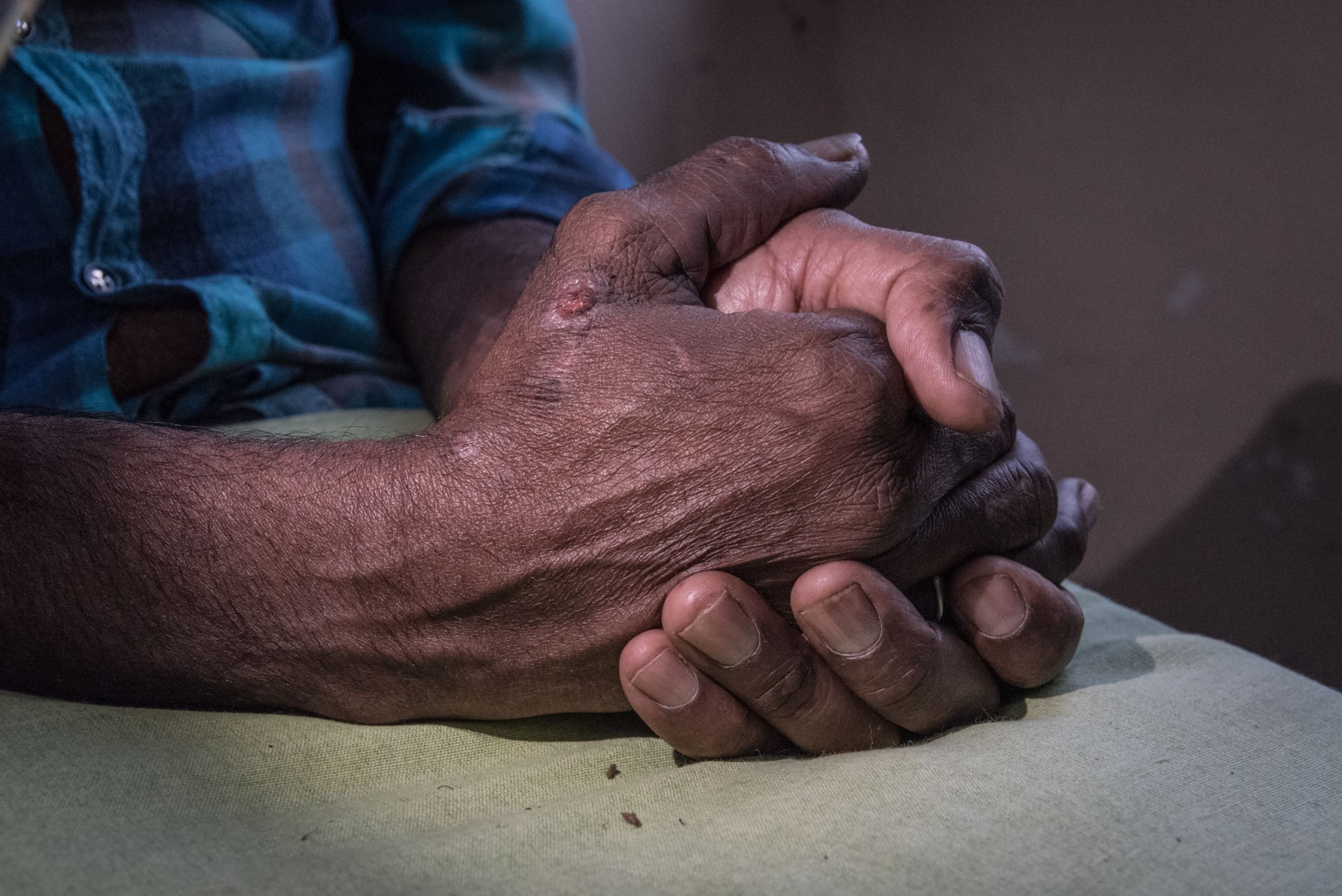
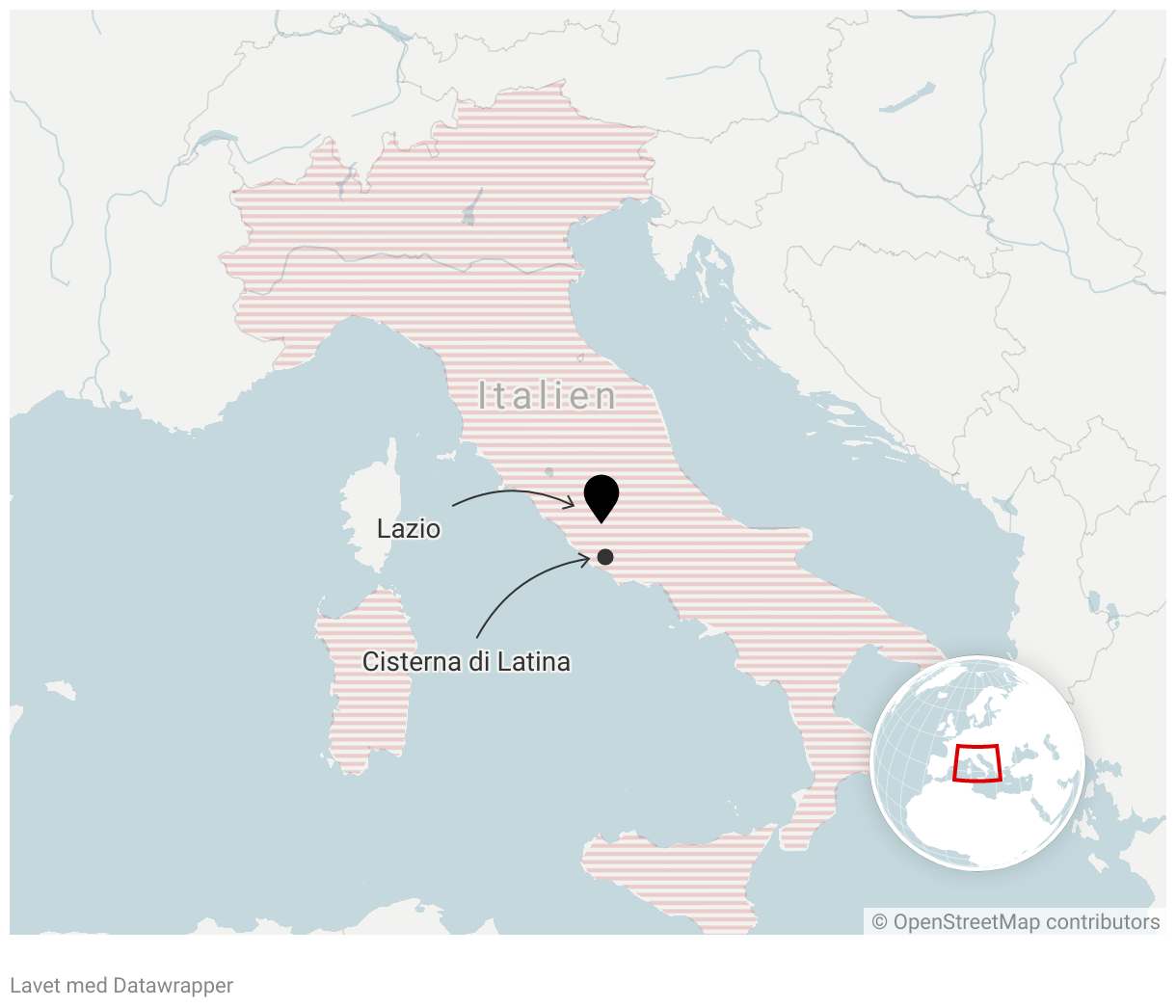
Gurjinder Singh comes straight from the field to speak with us and apologizes for not being able to clean off the dirt that is ingrained into his hands.
"I scrub them with shampoo and lemon, but I just can't get it off," he says, hiding his hands that look just as wounded as his soul.
Just two days earlier, Gurjinder Singh started a new job in the provincial capital Cisterna di Latina with a different orchard owner, who he hopes will treat him better and keep his promise of an employment contract, an hourly wage of 5-6 euros and an eight-hour working day.
Several of the 50-60 other farm workers there have told him that it is a bearable place. But he is not sure whether or not this is true.
As Gurjinder Singh talks about life as a kiwi worker, two of his new colleagues sit next to him and nod. Because his story is their story too.
Ten different kiwi workers revealed to us, with little variation in their stories, how orchard owners systematically manipulate their pay slips and do not pay the agreed minimum wage, which is around nine euros an hour.
The trick is really quite simple, they explain.
Every month, employers record far fewer days and hours on their pay slips than the employees actually work. Instead, part of their hourly wage is paid to them on the side, at a much lower rate and often in cash.
Their average hourly wage then ends up being 5-6 euros per hour - a third less than the wage the orchard owners should have paid them.
And in that way, employers don't have to pay full wages for labour and they don't have to pay a lot of taxes. Giovanni Gioia, president of the La Confederazione Generale Italiana del Lavoro (CGIL) trade union in Lazio, explains.
That he estimates that the scam costs the Italian state billions in lost tax revenue every year, but there are no firm figures.
His office in Latina is plastered with posters baring red slogans and raised fists. He says that payroll fraud is widespread throughout the Italian agricultural sector and that it has been very difficult for the authorities and trade unions to tackle.
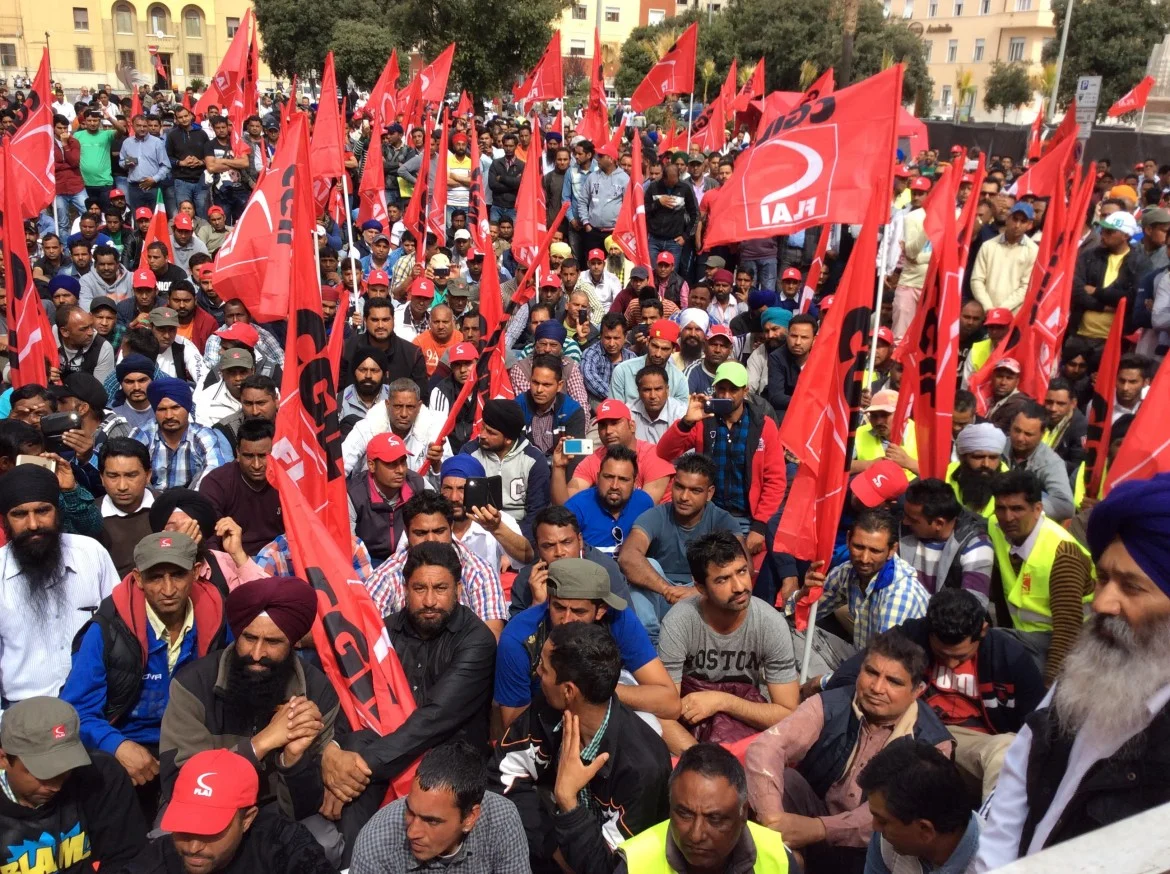
"Up to 90% of the payslips we see are fake. For example, orchard owners will claim three days of work per week at 6.5 hours per day, but in reality it is very different. The vast majority of farm workers work six or seven days a week from sun-up to sun-down", says Giovanni Goia.
The many workers we spoke to unanimously confirmed that working hours are typically 11-12 hours a day, six days a week.
Haning in his office in the provincial capital Latina, Giovanni Gioia's pride and joy is a large photograph from 2016 when GCIL motivated thousands of Indian farm workers to take to the streets to protest their conditions.
Since then, on average wages have risen from 3 euros to 5.5 euros. But otherwise, the conditions are pretty much the same, he says.

Like Gurjinder Singh, the rest of the Indian farm workers who tend to, water, pick, and pack the juicy kiwis in Lazio come from the Indian state of Punjab.
We went to northern India to visit some of the villages where families send between 400 and 500 sons, husbands and fathers every day to work in the US, Canada and Europe.
Although Punjab is known as India's breadbasket, the economic prosperity of recent decades has not reached the remote villages, and money sent home by migrant workers plays a major role, especially for poor farmers.
It's Sunday in the grand Shaheed Baba Bihal Singh temple in Talhan village outside Jalandhar, Punjab's third largest city.
From all over, turbaned men, women in colorful saris, and families with children flock to the temple to participate in the daily prayer.
Inside, between the temple pillars, several of the children play with the brightly coloured model airplanes they bought at the market outside the temple. 1.70 euros for the smallest, 5.30 for the most expensive.
Most of the airplanes are still wrapped in crackling cellophane, because they're not meant to be played with. The planes are to be given as offerings at the temple to ensure that an older brother, father or uncle can get one of the coveted visas to the West. For the skilled, it's the US and Canada, for the unskilled it's Portugal and Italy.
One by one, the colourful airplanes are piled in front of the flower-covered dais where the temple's priest Baljit Singh is about to preach.
"Every day, visitors give up to 1,000 airplanes as offerings, on Sundays there can be up to 3,000-4,000," he says.
The planes symbolize the dream of travel, the dream of a better life in the USA or Europe. A dream which is shared by almost every child and adult we spoke to in the village.
And it's a dream that many are making a reality: the Indian media estimate that Italy alone is home to more than 220,000 workers from Punjab.
"People see that offering up an airplane works for others. And then they think, why not try it themselves," says the priest.
"Does it work? Yes, of course it works," he says with a smile. "If you offer an airplane with sincere faith in God and in yourself, it will work".
In Punjab's villages, large villas testify to the prosperity of some of the families who have sent their sons and daughters to the West. One villa is known as Italy waleya di Kothi, "The House of those who live in Italy", another as England Wale "The Englanders".
But Baljit Singh knows that not all dreams become a reality in Europe.
"I am aware of that. But it has become our culture to travel", he says, while emphasizing that it is a tradition that it saddens him.
"I don't think that those who are doing well here should leave. But there are many young people who have no future here. Even if you are well educated, it is very difficult to find a job. That's why people leave. They hope for a brighter future and better quality of life," he says.
But it's one thing to offer model airplanes at the temple, it's quite another to leave.
And most people will need a little more practical help than what the priest can offer.
In the provincial capital of Jalandhar, home to around one and a half million people, travel agents in their hundreds advertise trips to Europe with a promise of a job and a bright future.
We got in contact with five travel agencies to see what they charge for sending a young man to Italy.
We tell the travel agents that we would like to buy a flight for the journalist's brother, Manjit Singh, and ask them how much it would cost to fly him and how it would work if, for example, he wanted to work at an Italian kiwifruit farm.
All five agents are very eager to arrange flights for the journalist's brother, but the prices and practical details of the trip vary dramatically. At one agency, the agent wants at least 13,5 lakh rupees to get a visa to the Schengen area, which includes Italy.
This is equivalent to approximately 17,000 euros.
"If your brother gets a Schengen visa, he can travel freely within that region, including Italy", the agent promises.
Another travel agent wants 8.5 lakh rupees to send Manjit Singh to Malta. This is equivalent to approximately 10,000 euros. How Manjit gets from Malta to Italy would be up to him, the agent explains.
However, none of the travel agencies can promise that Manjit will secure a job if he makes it to Italy.
"He'll have to get one himself when he gets there", they all respond.
Despite the exorbitant price of a visa and airfare to Italy, the Indian government estimates that around 487,000 young people left Punjab to work abroad between 2016 and February 2021.
It is usually a family initiative, often with the eldest son designated to go and secure a prosperous future for the whole family, according to the several families we meet in Punjab. And several of the Indian kiwifruit workers we interviewed in Lazio confirm this too.
Sometimes the worker's extended family manages to raise the money, but otherwise young people borrow money from the richest families in the village or from loan sharks. Often by mortgaging the family's property, they explain.
For Gurjinder Singh, it cost more than 100,000 euros to reach Italy. A debt that took him almost four years to repay.
In the square in Latina, he says he had no choice. It was his family who decided that he went, even though he already had a wife and four children at the time.
Today, almost 16 years later, he still has no choice, he says. Due to COVID-19, he has not been able to see his family for the past three years, and for the thirteen years before that, he had no money to travel home. It has not been possible to verify whether this is true. But now in the spring of 2023, things are looking up for him and he expects to be able to travel to Punjab for a holiday.
However, once his holiday is over, the Italian kiwi orchards will call to him once more, he says.
"I have to return to Italy. I come from a very poor family. My three oldest children are married now, but I still have my wife and an 18-year-old son who lives at home and is dependent on my income", he says.
Today Gurjinder Singh is debt-free, but all the Indian workers we spoke to in Lazio and Punjab said they had to pay between 14,000 and 18,000 euros to get to Italy.
And no matter where the money comes from, the obligation to pay back their debt is the same, they say.
Otherwise, the worker's family back home in Punjab risks paying back extortionate interest to a moneylender, or if things go terribly wrong, they risk losing their home and land. And on top of that, it is also a matter of honour to pay back debt.
Like Gurjinder Singh, all the Indian kiwifruit workers we met spent between three and four years paying off the loans they took to get to Italy.
This has prompted trade unionists like Giovanni Goia and human trafficking experts to talk about debt slavery.
"Modern slavery is no longer about being chained and forced against one's will, in the manner of the transatlantic slave trade. Today, it concerns vulnerable people who have, for example, gotten into debt and cannot leave their job, even if they are being exploited", says Sine Plambech, Senior Researcher at DIIS.
No posts
Someone who experienced an extreme form of modern slavery is Balbir Nikah Singh, now 49, whom we meet while in the provincial capital of Cisterna di Latina.
Today he lives in a single room annex with a kitchen and bathroom in Latina. But he has never had it so good. For more than six years, he admits he was a "slave" on a farm near the small coastal town of Borgo Sabotino.
When his long days as a farm worker were over, Balbir Singh lived in an old caravan with no light, heat, water or gas.
"If I wanted to bathe, I had to use the hose we had in the barn - the same one I used for the cows. And if I was hungry, I had to rummage through the family's garbage bin or eat the leftover food they fed to the farmyard chickens and pigs," says Balbir Nikah Singh.
His story is varified by several other sources who have had similar experiences, as well as a number of court documents and photos which Danwatch have viewed.
But worst of all, the salary that would have secured his own stay in Italy and enabled him to bring his wife Surinder Kaur and their two daughters to Europe became less and less.
"I dreamed of a bright future for me and my family. My wife was supposed to come to Italy too, but that dream was crushed by my employer", says Balbir Singh
"I worked 12-13 hours every single day, seven days a week. I never had a day off and the salary I received was getting smaller and smaller. Some months I only got 50 or 100 euros. In the end, there were months when I didn't get paid at all".
To this day, the former primary school teacher from Punjab is ashamed that he put up with those conditions. But the farm owner had taken his passport. And without a valid residence permit, he could not travel anywhere.
"Where would I go without a passport and papers. And what's more, the son in the house threatened to kill me if I tried to run away".
Fortunately, Balbir Nikah Singh eventually managed to escape.
Before dawn on the morning of March 17, 2017, the Italian police, the carabinieri, stormed the farm in Borgo Sabotino arresting the entire family and freeing Balbir Singh.
No posts
Today, Balbir Singh is still a farm worker, but now on a kiwi orchard, where despite everything conditions are better. The working days are still many and long, and hourly wages do not exceed 5.50 euros.
But he is the first migrant worker in Italy's history to be granted a permanent residence permit because of what he has endured.
And he is one of the first Indian migrant workers ever to take his former employer to court, both to seek justice for the humiliation he suffered and to raise awareness of the plight of migrants.
"I really hope that even my worst enemy will never have to go through what I have been through", he says.
In addition, he also hopes that his former employer will be forced to pay him back for all months that they did not pay his wages.
"Today, I am a free bird and I am not giving up", he declares. "Your mother gives you the gift of life, but what you achieve with your life depends solely on your personality and your own actions".
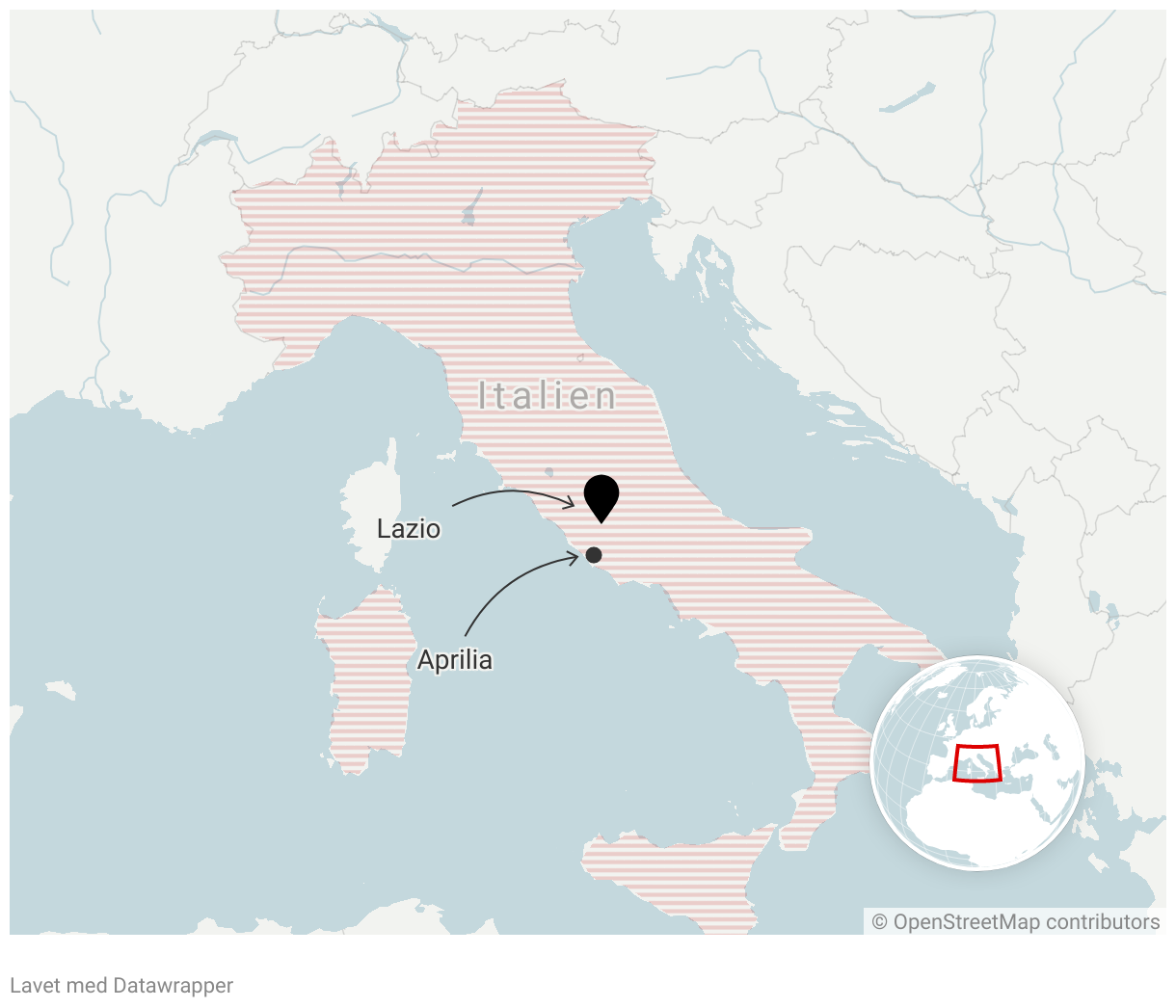
Although Balbir Nikah Singh's fate led him down an extreme path, his experience shows how vulnerable Indian migrants are when they end up on an Italian orchard, often without knowing the language or their rights.
Marco Omizzollo, Professor of Social Anthropology and Migration at La Sapienza University in Rome, specializes in the conditions of Indian migrants in Lazio.
As well as researching this field, he has worked undercover in the area.
For three months, he lived and worked with the Indian migrant workers in the village of Bella Farnia, south of Latina, and has since published several books about his experiences and the system of travel agents, orchard owners and others who make money from exploiting the poor workers from Punjab.
This has made him quite unpopular and, after a series of threats from who he refers to as the 'Italian agricultural mafia', he now lives and works at a secret address.
Therefore, our meeting with him takes place in Parco Europa in Aprila, one of the smaller towns in the area.
"The exploitation of Indian migrant workers is severe and widespread. It is mainly agricultural workers who are exploited, but many of them are also victims of modern human trafficking", says the Italian researcher.
"They are lured to Lazio by people who make large sums of money to bring them to the area, and most of the time the workers only get a fraction of what they have been promised", he says.
In addition, many of the Indian workers in Lazio are subjected to both physical and psychological violence, his research shows.
However, it is not only in the kiwifruit industry or in Lazio province that the exploitation of guest workers takes place.
According to Urmila Bhoola, the UN Special Rapporteur on modern slavery, up to 400,000 agricultural workers in Italy are at risk of exploitation.
This is according to a comprehensive report she prepared for the UN Human Rights Council on the issue. She also concludes that almost 100,000 live in what she describes as "inhumane conditions".
Marco Omizzolo has been involved in migrant workers' rights for more than a decade and was knighted in 2019 for his "courageous work" in exposing working conditions in Lazio.
He believes that conditions have improved slightly in recent years, particularly in terms of pay. But at the same time, the exploitation of workers has become more sophisticated.
"For example, some orchard owners pay yo-yo wages, a term describing an employer who pays wages in full but requires their workers to withdraw 200-300 euros the next day and return it to them in cash".
As CGIL union leader Giovanni Goia confirms, orchard owners have been adept at adapting to increasing controls and making areas of their exploitation invisible.
However, he agrees with Omizzolo that conditions have slightly improved in recent years.
After interviewing the ten Indian kiwi workers about the conditions they work under, the
IrpiMedia, The Wire and Danwatch were eager to talk to some of the orchard owners who have been accused of underpaying workers, manipulating their pay slips, verbally abusing them, shaming them and in some cases filming and firing the Indian employees.
However, despite several attempts, it was not possible to get in touch with the owners or to even get a tour of the orchards.
"Call a different number". "Call again" "Come again another day". "The owner's not home".
"There's no one else who can talk to you" is their answer, when we call and, in many cases also when we go to the address to speak with them.
However, according to the UN Principles on Human Rights and Business, responsibility does not end there. According to the guidelines, all companies in the supply chain are jointly responsible for any negative impacts on human rights and the environment.
The next step in the supply chain are a series of Italian wholesalers who buy kiwifruit from the many orchards in Lazio and export them to the rest of the world.
The workers we spoke to are employed on kiwi orchards who, among others, supply Apofruit, Kiwi Pontino, Salvi, Zani Granfrutta and Zeolifruit. All of whom supply kiwifruit to Danish supermarkets.
However, none of these five companies wanted to be interviewed.
THE FACTS
According to the UN Guiding Principles on Business and Human Rights (UNGPs), every link in the supply chain is responsible for what goes on in Italian orchards. Below the diagram, you can read the full reactions of the individual wholesalers and Danish supermarket chains selling kiwifruit from Lazio.
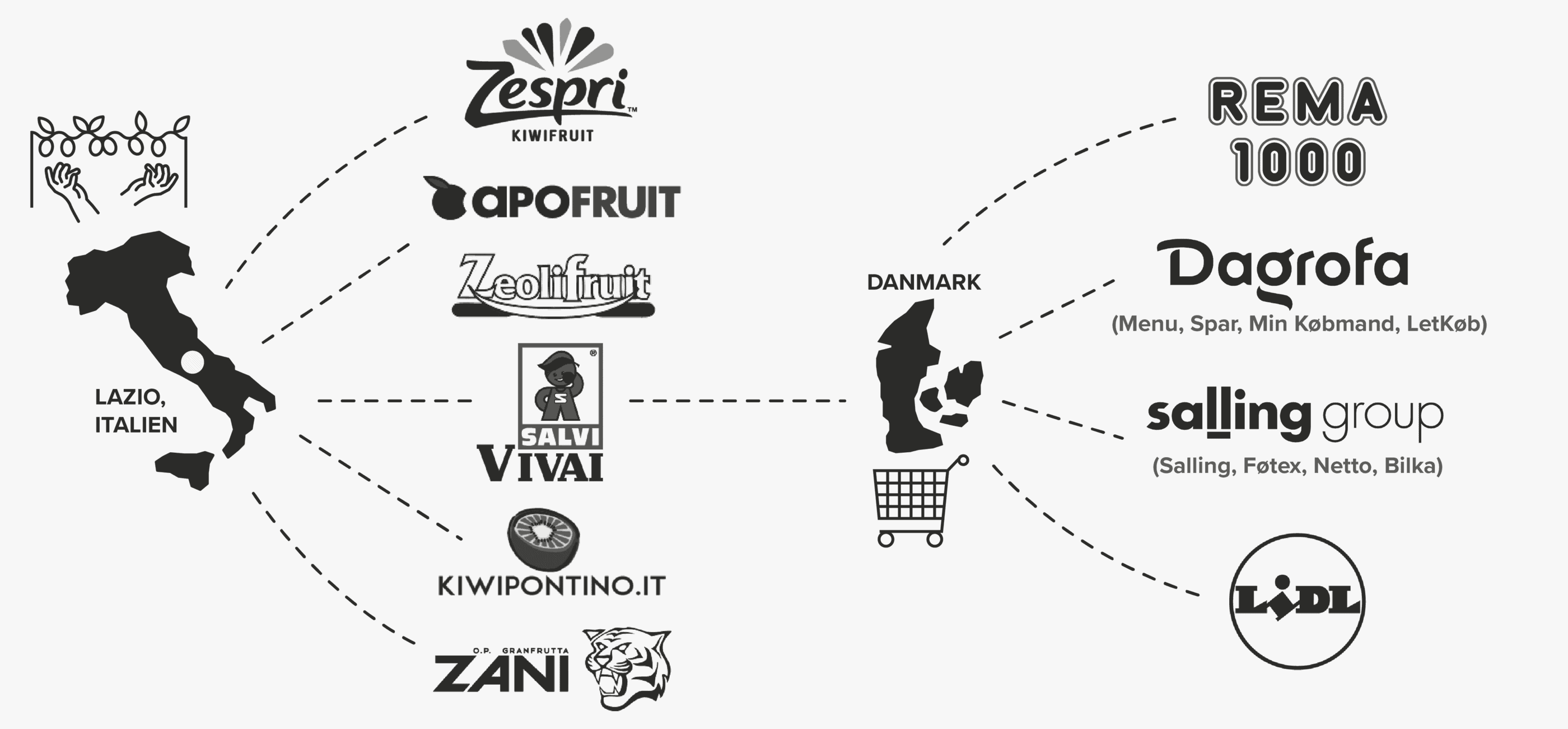
Apofruit denies all responsibility and in short points out that all their suppliers have the GRASP certification, which sets a number of requirements for transparency and working conditions.
Zeolifruit refuses to cooperate and Salvi did not respond to our inquiries at all.
At Zani Granfruttai, however, they were more responsive.
Quality Manager Enrico Foschin responds in an email that they carry out random checks on the 80 percent of their suppliers who are currently GRASP-certified.
"Here we inspect contracts, pay slips, check the respect of workers' rights and working conditions, conduct regular meetings between workers' representatives and employers, including interviews with workers", he writes.
"If we find ethical and social problems on farms, in the most serious cases, this can lead us to terminate the cooperation".
Enrico Foschin does not address the reports of hourly wages of 5-5.6 euros, verbal abuse, falsification of pay slips. Or the issue of migrant workers' indebtedness and their heavy dependence on the orchard owners.
At Kiwi Pontino, however, an unnamed project manager flatly denies that the problems have anything to do with them.
"These allegations cannot relate to the situation at Kiwi Pontino", he writes.
"Our employees are treated in full compliance with the rules, but above all we respect them. After all, it is our employees who are responsible for the daily production and they are an important part of our business".
In addition, Kiwi Pontino underlines that the Italian authorities monitor the company and the company has always cooperated with them, giving the authorities access to all parts of the company.
On the other side of the world, near the extinct Maunganui volcano in northern New Zealand, lies the world's largest exporter of kiwifruit, Zespri International.
It is a global company that in recent years has become a major player in kiwifruit production and exports from Italy.
According to the UN Food and Agriculture Organization (FAO), who collect agricultural statistics from around the world, Italy is currently the world's third largest producer, with an annual production of 420,000 tons of kiwifruit.
And Zespri is playing a key role in this development, explains the company's Head of Communications Yannis Naumann. Every year, Zespri invests in establishing several new kiwifruit orchards, and by 2023, Zespri will be buying and exporting kiwifruit from no less than 1,200 orchards in Italy, which it will sell on to a large number of countries, mainly in Europe, including Denmark.
According to the Zespri's website, the global kiwifruit company is committed to sustainability and its employees. It states, among other things, that Zespri will "work to ensure that all employees are valued, protected and supported in their work".
"We will attract talent and continue to build a thriving workforce amongst our value chain by 2030. Thriving means continually improving social practices in relation to working conditions, pay, health & safety, development, and diversity and inclusion", as stated in the company's sustainability statement.
But how does this relate to debt slavery, underpayment and the exploitation of Indian migrant workers in Italian kiwi fields?
We would have liked to ask Zespris CEO Daniel Mathieson what they, as major players in the Italian market, are doing to ensure decent conditions in the kiwifruit industry.
But Zespri has declined this. Instead, Nick Kirton, Zespri's European head, replied to us by email:
"We take the allegations of exploitation extremely seriously and have launched an investigation into the situation, including how best to support the workers concerned," he wrote.
"Among other things, we have contacted all our Italian suppliers, expressing our concerns about the alleged practices and reiterated the requirements for worker welfare as a condition for supplying Zespri".
Nick Kirton, like the Italian wholesalers, emphasizes that all their suppliers have GAP certification. "And on top of that, Zespri also has a set of core values that all our suppliers have to live up to," he says, adding that the organizations that certify for Zespri in Italy have also been contacted.
"The vast majority of employers in the kiwifruit industry take good care of their people," Nick Kirton points out.
"But there may be a small minority who do not. Any form of worker exploitation is unacceptable and we will ensure that those involved are held accountable and we will continue to improve our control systems to ensure that this does not happen," he says, urging anyone with information about poor labour practices in the Italian kiwifruit industry to contact Zespri via the company's confidential hotline EthicsPoint - Zespri International.
But the supply chain does not stop with the Italian wholesalers or the major international exporter Zespri.
According to Statistics Denmark, two out of every three Danish kiwifruit come from Italy. In fact, Danish stores import at least 2000 tons of kiwifruit from Italy every year.
With the help of Danish supermarket chains, website searches, social media, promotional magazines, visits to various stores and lists of producers found on the internet, Danwatch, IrpiMedia and The Wire have managed to piece together the kiwifruit supply chain all the way back to Denmark.
We discovered that Lidl, Salling Group, Dagrofa and Rema 1000 all sell kiwifruit originating from Lazio. Together, the four retail groups own the supermarkets Lidl, Netto, Føtex, Bilka, Meny, Spar, MinKøbmand, LetKøb and Rema1000. All of which import kiwifruit from Lazio - either directly from Italian wholesalers or from the major international exporter Zespri.
Despite several requests, none of the four food corporations would agree to be interviewed about the conditions in Lazio's kiwifruit orchards.
At Lidl's Danish head office in Kolding, head of communications, Thomas Sejersen, refuses to divulge who supplies kiwifruit to Lidl, nor does he answer direct questions about the conditions of kiwifruit workers.
However, according to Lidl's international website, Zespri is a kiwifruit supplier for Lidl. And it was from Lidl's central communications department in Neckarsulm in southern Germany that, after many attempts, we finally received a response via email.
Like several of the wholesalers, an unnamed Lidl spokesperson explains that all their fresh produce producers have to fill in a declaration of GAP certification.
"Lidl has a zero-tolerance policy towards any kind of human rights violations in our supply chains", writes the communications department, emphasizing that Lidl is committed to the UN Guiding Principles on Human Rights and Business (UNGPs).
In addition, the German-owned chain says it has a whistleblower hotline for complaints, and Lidl promises to investigate all specific reports of violations of its code of conduct.
We asked the communications department if they thought that the Indian kiwifrui workers in Lazio would know that Lidl buys the kiwifruit they pick and if they would see the point in complaining to their hotline.
"We have been using the system for several years and can assure you that the system is accepted and used", Lidl writes. However, to date, Lidl has not received any complaints about kiwifruit suppliers or orchards in Italy.
Norwegian-owned Rema 1000, which currently has 363 supermarkets in Denmark, also confirmed that it gets some of its kiwifruit from Lazio.
According to Communications Manager Jonas Schrøder, nine different producers and wholesalers are involved, including Zani, who exports kiwifruit from the Lazio province.
However, in an email response, he writes that Rema 1000 does not recognize the reports of debt slavery, underpayment, wrongful dismissal, verbal abuse or the falsification of pay slips.
"We have not found there to be any violations and our supplier certainly does not believe that there are any violations in his supply chain", Jonas Schrøder writes, but acknowledges that Italy does not have the best reputation when it comes to worker conditions.
"We are in close contact with our kiwifruit suppliers and we have assessed Italy as a medium-risk country in terms of human and labour rights violations," he writes.
"As our kiwifruit suppliers are GRASP certified and have signed our Code of Conduct, we are confident that working conditions are in order".
He does not elaborate on the basis of this trust.
The Dagrofa group currently has 511 stores, including 111 Menu supermarkets, 124 Spar supermarkets, 163 Min Købmand supermarkets and 113 LetKøb supermarkets, and it also sources its kiwifruit from Italy, including organic kiwifruit from Lazio.
Dagrofa responds to Danwatch in an email.
However, no upper management members from the large group, which employs more than 13,000 people, are willing to be interviewed about the problems in the Italian kiwifruit sector.
However, Henrik Johannsen, Dagrofa's CSR manager, writes in an email that the group will pursue the matter further.
"We take note of Danwatch's observations from the area and will continue to work with the limited information you have made available to us. Currently, we have arranged a joint meeting facilitated by the Danish Ethical Trade Initiative Denmark for further dialogue", he writes.
Dagrofa would not elaborate on the exact purpose of the meeting or who will be in attendance, but the Danish Ethical Trading Initiative network subsequently has invited Danwatch to the meeting to discuss possible solutions to the working conditions in Italy.
Another supermarket chain also buying kiwifruit from Lazio is Salling Group, who operates more than 1,700 stores across the Bilka, Føtex, Netto and Salling chains.
According to Salling Group's website, the group has signed up to the UNGuiding Principles on Business and Human Rights (UNGPs), the OECD Guidelines for Multinational Enterprises and several other similar guidelines, all of which emphasize the company's commitment to respecting human rights.
Therefore, Danwatch has asked Salling Group what they are doing to ensure good working conditions in kiwifruit production, and what they are doing to rectify the conditions unearthed by our investigation.
"We are aware that throughout Europe, and particularly in Southern European countries, migrant workers are used in the agricultural sector," writes Henrik Vinther Olesen, Deputy Head of Communication and Sustainability.
He assures us that Salling Group takes Danwatch's findings "very seriously" but has not witnessed the conditions we have described.
"We are in continuous dialogue with our suppliers, and all our manufacturers are subject to social audit documentation requirements, and no deviations of this type have been observed," writes Winther Olesen, but promises to investigate the matter further.
Henrik Vinther Olesen does not elaborate on how Salling Group intends to do this.
This article has been produced in collaboration with IrpiMedia and The Wire. The project has received funding from Journalismfund.eu.